
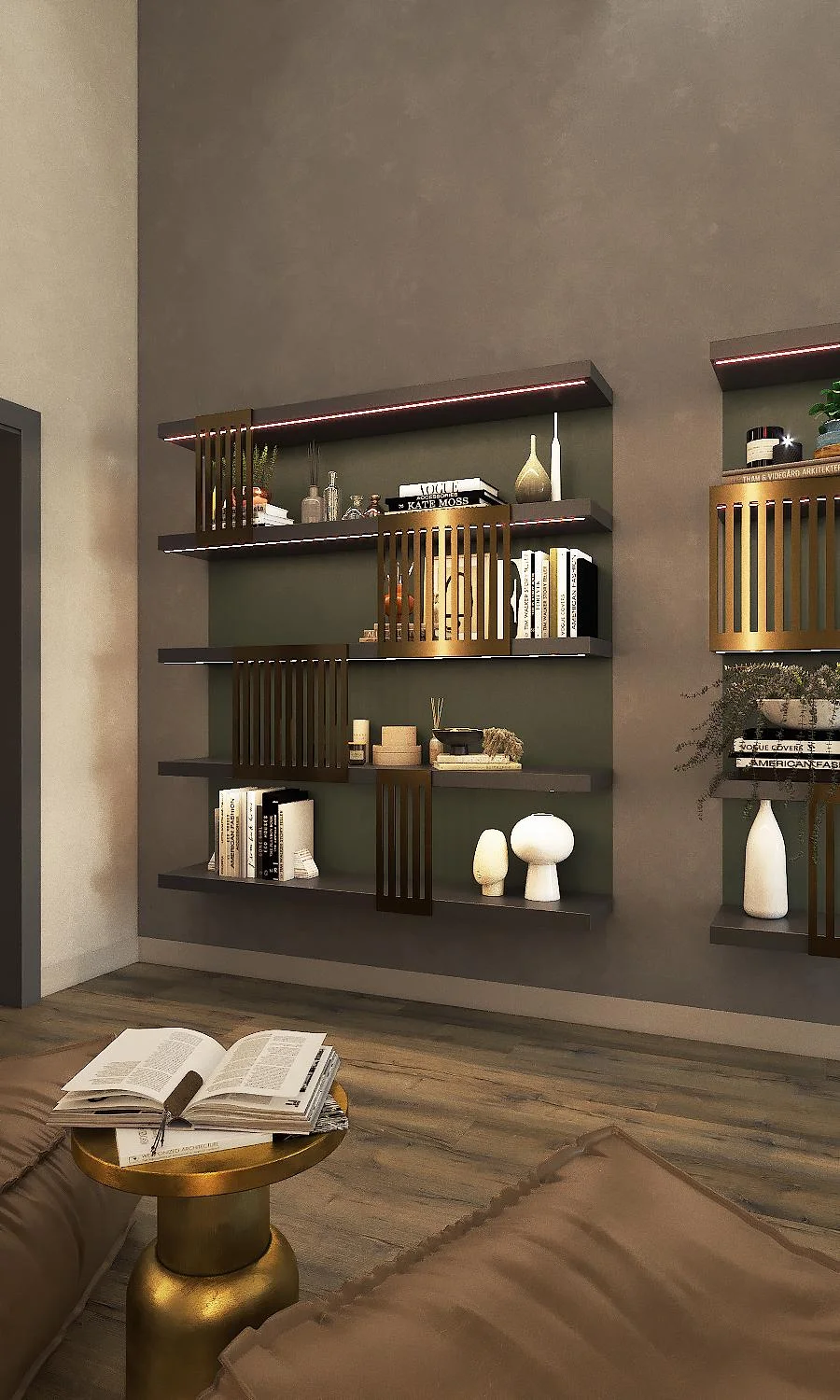
Shelves can be so much more than a practical place to store books and everyday objects. I love how the right shelving design can transform an empty wall into a stylish focal point while adding useful storage at the same time. From sculptural built-ins and softly illuminated displays to simple floating shelves and slim vertical solutions, there are countless ways to make shelving feel intentional. The key is finding a balance between function, proportion, lighting, and the decorative pieces you genuinely enjoy seeing every day. In this collection, I’m exploring creative home shelf ideas that show how different layouts and styling choices can completely change the character of a space. Which shelving idea will inspire your next room update?
Geometric Built-In Shelving With Warm Integrated Lighting
I love how this living room combines a blue-gray built-in shelving unit with warm wood-toned geometric dividers. The shelving sits beside a television and above a low cabinet, creating one continuous feature wall. Each open compartment has a slightly different triangular or angled shape, while discreet lighting follows the shelves and gives the display a soft glow. Books, small sculptural objects, vessels, and a few decorative pieces are arranged throughout, while the marble-look surface below adds another layer of texture.
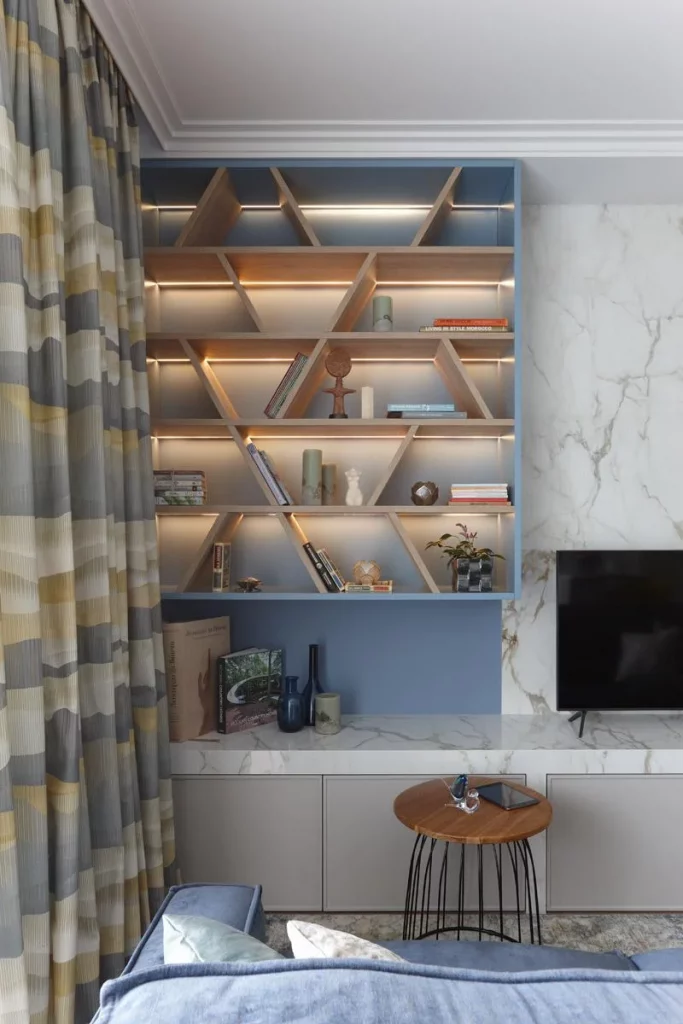
What makes this arrangement work for me is the balance between strong geometry and relaxed styling. The shelves themselves provide plenty of visual interest, so the accessories do not need to be excessive. I also like that the illuminated compartments separate individual displays without making the wall feel cluttered. The lower cabinetry provides a quieter visual base, allowing the open shelving to remain the focal point.
If I were recreating this look, I would pay particular attention to the proportions of the compartments rather than simply choosing ordinary rectangular shelves. The angled dividers create movement and make the storage feel architectural. I would also use warm integrated lighting sparingly and style each compartment with a combination of books and a few objects, leaving some negative space so the geometric structure remains visible.
Illuminated Display Shelf Framing a Hallway
This hallway takes a completely different approach, using a tall, narrow built-in display niche with a deep burgundy or dark red frame. The shelves run vertically beside the passage, and warm orange lighting fills each compartment. Small decorative objects are placed individually inside the illuminated openings, creating a striking sequence as the eye moves down the corridor. The opposite side contains a staircase with dark stair treads and a matching dark vertical element, while the pale floor and walls keep the passage visually open.
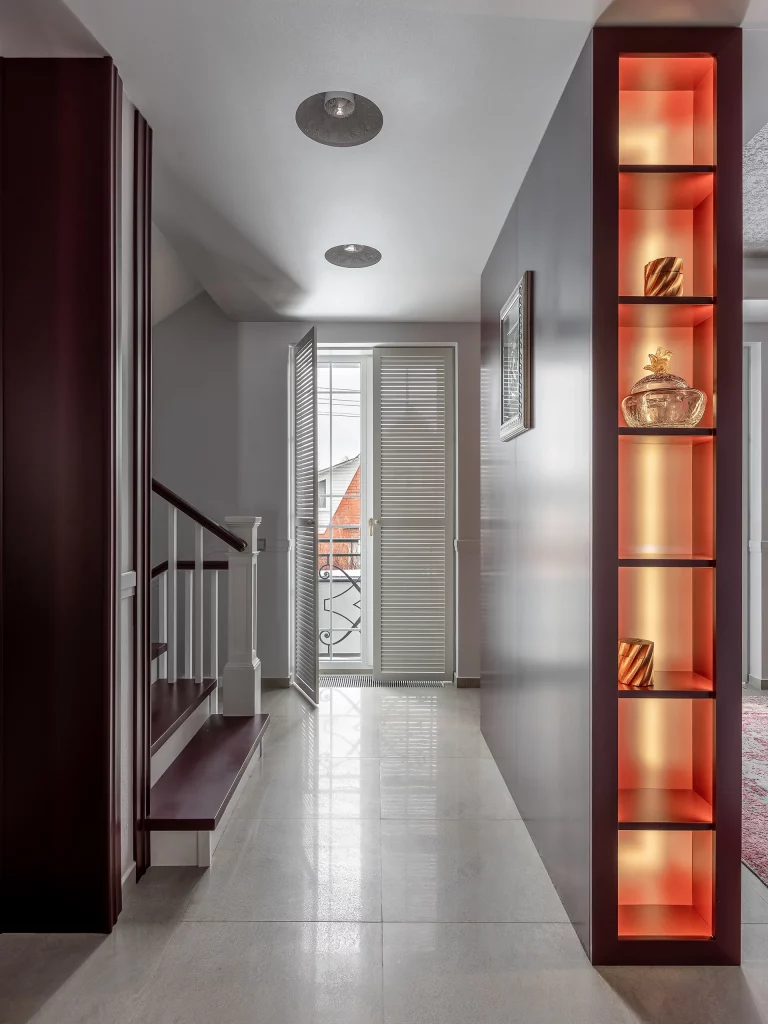
For me, the strongest feature is the way the shelving transforms an otherwise transitional hallway into a destination of its own. The narrow vertical footprint uses space efficiently without obstructing the walkway, while the lighting gives the corridor depth. Because each shelf contains only one or two objects, the display feels intentional rather than crowded.
I would use this idea when a hallway has an awkward narrow section that cannot accommodate conventional furniture. A tall recessed or built-in shelf can make use of that vertical space while remaining shallow enough for circulation. The image also reminds me that lighting can completely change the character of open storage; here, the warm illumination makes the display feel almost like a series of small exhibition cases.
Sculptural White Shelving With Layered Open Compartments
I find this shelving design especially interesting because of its sculptural construction. Several tall white vertical forms extend from floor level toward the ceiling, with warm-toned shelves positioned between them at different heights. The irregular arrangement creates a rhythm across the wall, while the pale finish keeps the overall composition light. Books, rounded vessels, small sculptures, and other decorative objects are distributed throughout the openings, with subtle lighting highlighting many of the shelves.
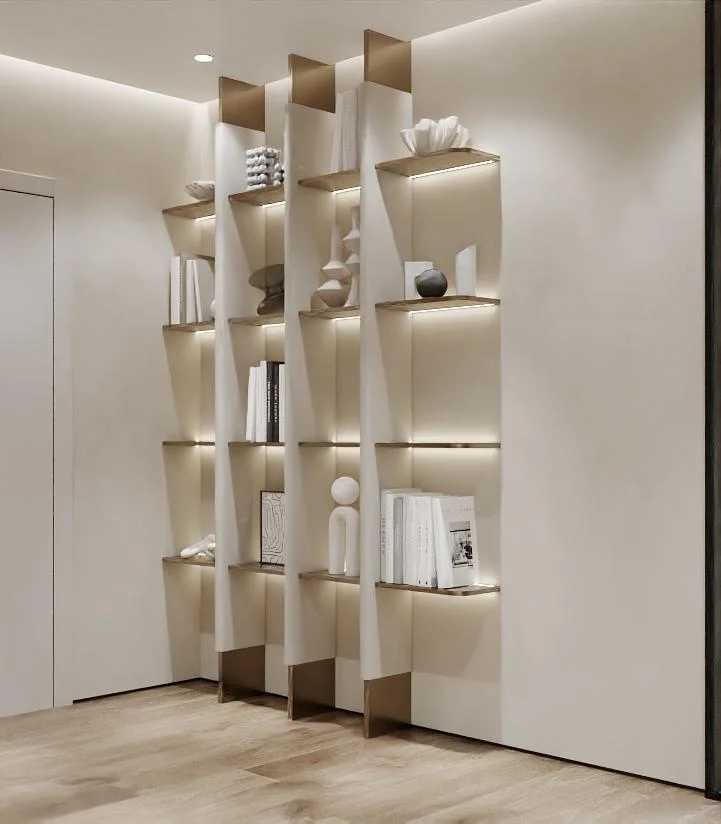
The beauty of this design comes from the combination of storage and architecture. Instead of looking like separate pieces of furniture, the shelves appear integrated into the wall composition. I particularly like how the varying heights create individual display zones while the repeated vertical elements visually connect everything together.
For a similar effect, I would think of the shelving as a sculptural wall installation rather than a conventional bookcase. Keeping the main structure restrained in color allows the shapes and objects to provide the visual interest. I would also avoid filling every opening completely; the image works because several compartments have breathing room around their contents.
Dark Built-In Shelves With Cozy Reading Corner
This room uses a dramatic dark shelving wall behind a compact cream-colored rounded armchair. The shelving is built into a black-framed section and includes several open compartments with integrated warm lighting. Books are stacked both vertically and horizontally, while white and metallic-looking vessels, small sculptures, and greenery add variation. Closed cabinetry occupies the lower section, creating a practical contrast with the open display areas above.
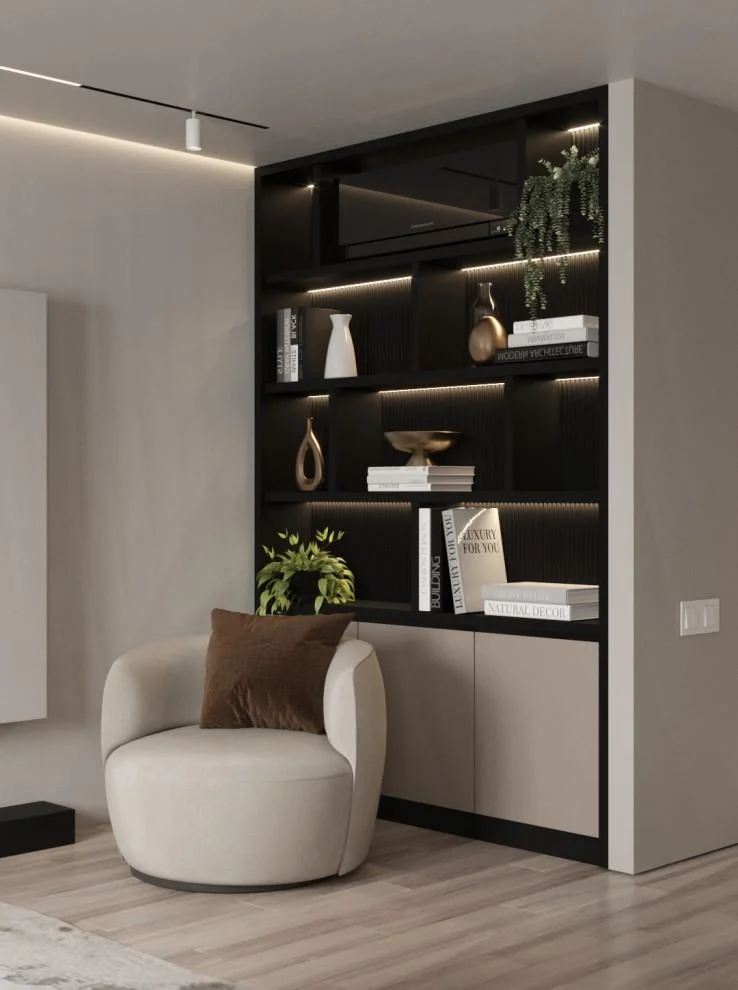
I like the way the shelving and chair work together as a small reading-oriented corner without requiring a large amount of furniture. The rounded chair softens the straight lines of the built-in storage, while the dark background gives the lighter decorative pieces more definition. The lower cabinets are particularly useful because they visually hide less decorative items and keep the open shelves focused on display.
If I were styling a similar wall, I would follow the same principle of mixing open and closed storage. Books can create height and texture, while a limited number of sculptural objects can break up the rows. I also think the warm shelf lighting is important here because it prevents the dark finish from feeling visually flat and creates a comfortable atmosphere around the chair.
Natural-Looking Floating Shelves With Casual Styling
Here, the shelving becomes much simpler. Several thick floating shelves with irregular, organic-looking edges are mounted against a warm beige wall. The shelves vary in length and are arranged asymmetrically. They hold books, small containers, glasses, and potted greenery, creating a relaxed display above part of a bed or upholstered seating area visible at the bottom of the image.
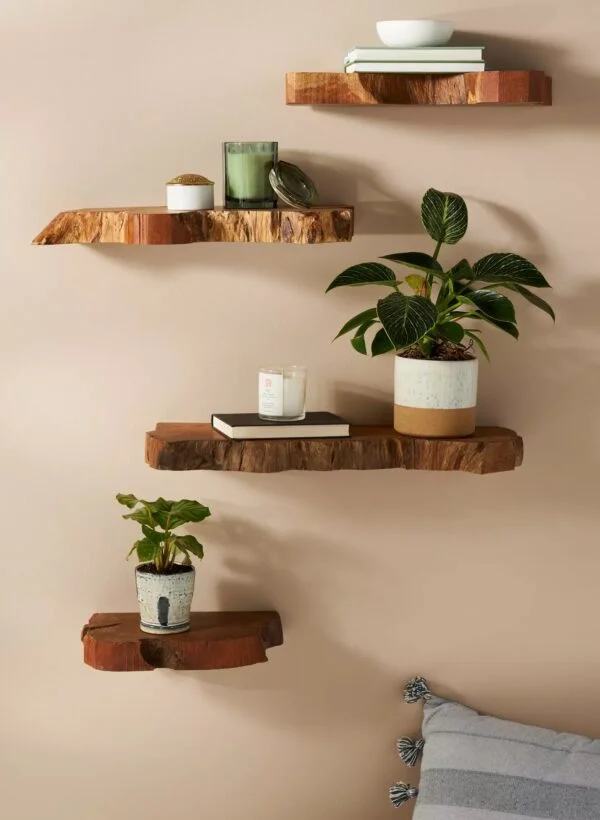
What I appreciate most is how little is needed to make these shelves feel finished. Their irregular edges already provide character, so the styling remains uncomplicated. The combination of books, small objects, and greenery gives each shelf a purpose without making the arrangement look overly coordinated.
I would use this approach when I want open shelving to feel approachable rather than highly architectural. The staggered placement keeps the wall interesting, while the different shelf lengths prevent the composition from becoming too rigid. I would also keep heavier objects toward the lower shelves and leave enough space around individual pieces so their shapes remain easy to see.
Soft Green Fireplace Wall With Open Display Shelves
This image shows a pale green wall organized around a white-painted fireplace opening. A long shelf sits above the fireplace, with books and a potted plant arranged along it, while another shelf crosses the wall above. The fireplace itself contains books, cylindrical decorative objects, and other small items. A framed textile-like piece, stacked books, photographs, and greenery add layers to the display, while a larger potted plant stands on the floor to the left.
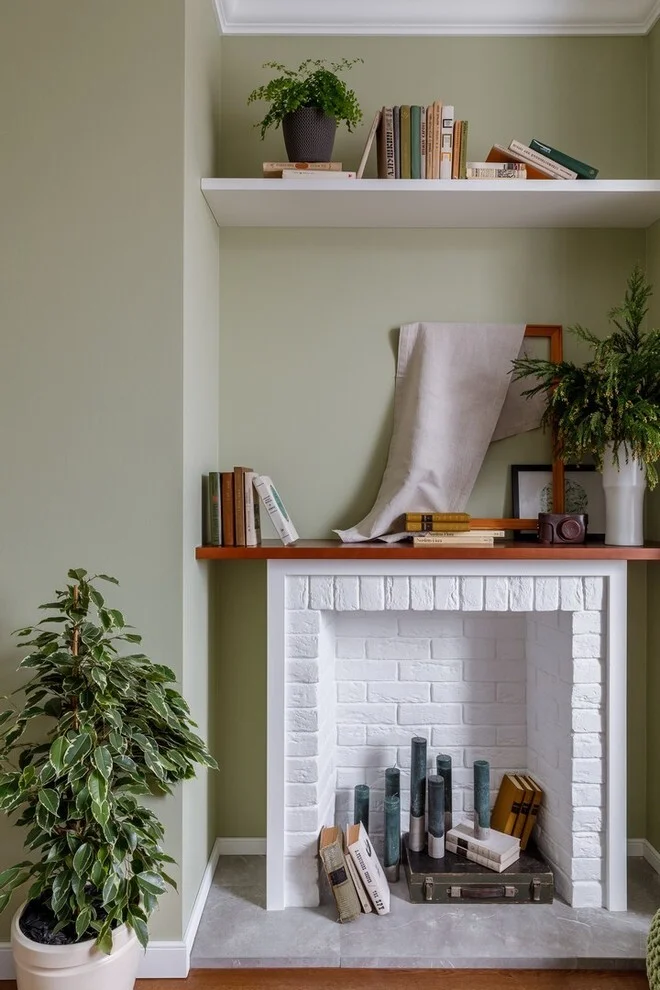
I like how the shelving gives this fireplace wall several levels of visual interest without overwhelming the architectural feature in the center. The shelves create useful display space above and around the fireplace, while the open area inside the fireplace becomes another styling zone. The restrained green-and-white setting also allows the books, photographs, and decorative objects to stand out naturally.
For me, this is a good example of treating shelving as part of the architecture rather than adding storage as an afterthought. I would begin by keeping the largest visual element, the fireplace opening, relatively clear and then build the display outward from it. Mixing horizontal stacks of books with upright books, framed pieces, and objects at different heights can create the same layered effect shown here.
White Built-In Shelving Turned Into a Personal Gallery
This white built-in shelving arrangement is filled with books, framed photographs, artwork, small house-shaped objects, candles, and decorative pieces. A framed painting occupies the center and overlaps part of the shelving, immediately becoming the visual anchor. A tall black vase with branches appears in the foreground, while a sculptural wooden hand sits prominently to the right. The shelves themselves are simple and white, allowing the collected objects to provide most of the personality.
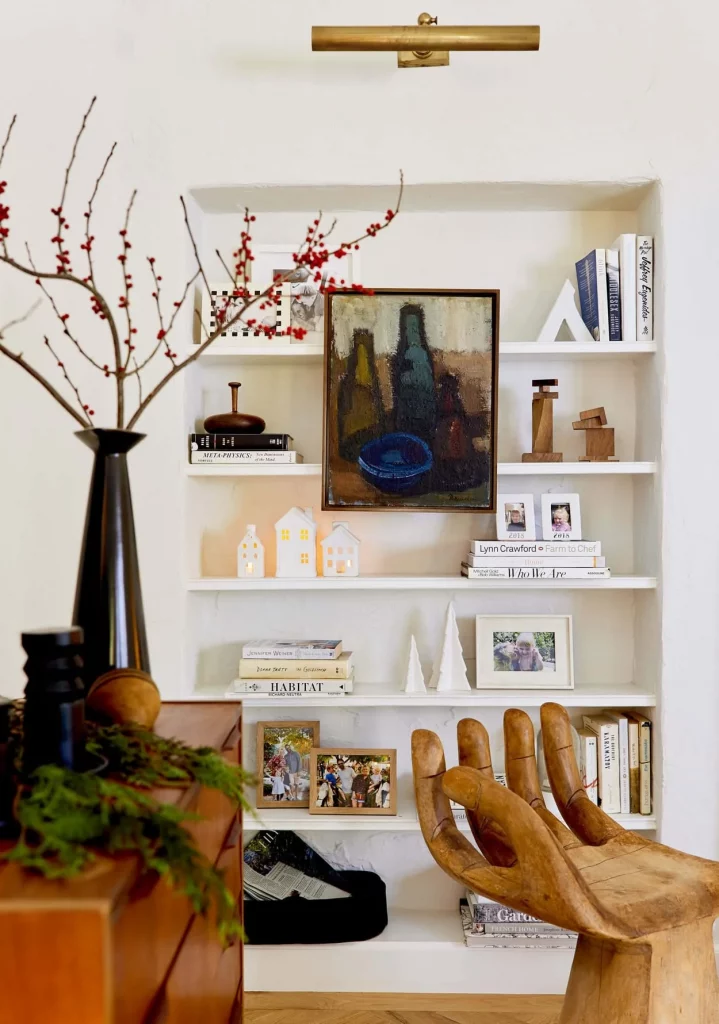
I especially like the personal feeling of this composition. Instead of making every shelf look identical, the display combines photographs, artwork, books, and objects with different shapes and sizes. The result feels like a collection built over time rather than a display assembled from a single matching set.
When I style shelves like this, I find it helpful to choose one or two larger pieces first and then work around them. Here, the central artwork and prominent foreground objects create strong focal points, while the smaller books and photographs fill the surrounding spaces. The important lesson is not to make every compartment symmetrical; a little visual imbalance can make a gallery-style shelf feel much more natural.
Slim Vertical Shelf Built Beside a Door
This compact shelving solution is fitted into a very narrow vertical section beside a white interior door. A tall dark cabinet sits to the left, while the slim open shelf has a warm wood-toned backing and dark framing. Small artworks, books, sculptural objects, and decorative pieces are arranged from top to bottom. The air-conditioning unit above the door and the simple pale walls make the narrow shelf stand out as a deliberate feature rather than disappearing into the background.
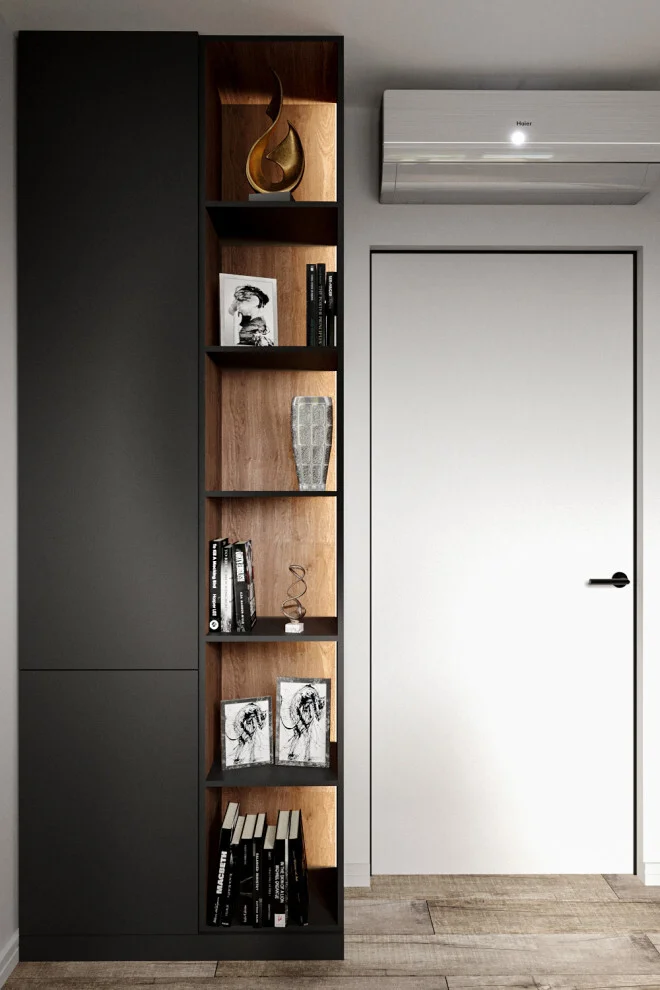
For me, this is one of the most practical ideas in the collection because it demonstrates how even a very narrow wall section can become useful. The shelf takes advantage of vertical space without taking over the room. Its limited width also naturally encourages a curated display, which helps prevent the area from becoming visually overloaded.
I would consider this type of shelving when there is a small gap beside a door, cabinet, or other fixed architectural element. A shallow vertical unit can provide a place for favorite books and small decorative objects without requiring a larger piece of furniture. Keeping the number of items controlled is especially important in a narrow shelf because every object remains highly visible.
Layered Dark Shelves With Decorative Slatted Dividers
This darker interior features several floating shelves arranged at different heights against a deep muted wall. Vertical slatted dividers interrupt parts of the shelves, creating smaller display zones and adding a strong linear detail. Books, bottles, vessels, candles, and sculptural objects occupy the compartments, while subtle strip lighting runs along the shelf edges. A small round table with an open book sits in the foreground, reinforcing the room’s comfortable, reading-focused atmosphere.
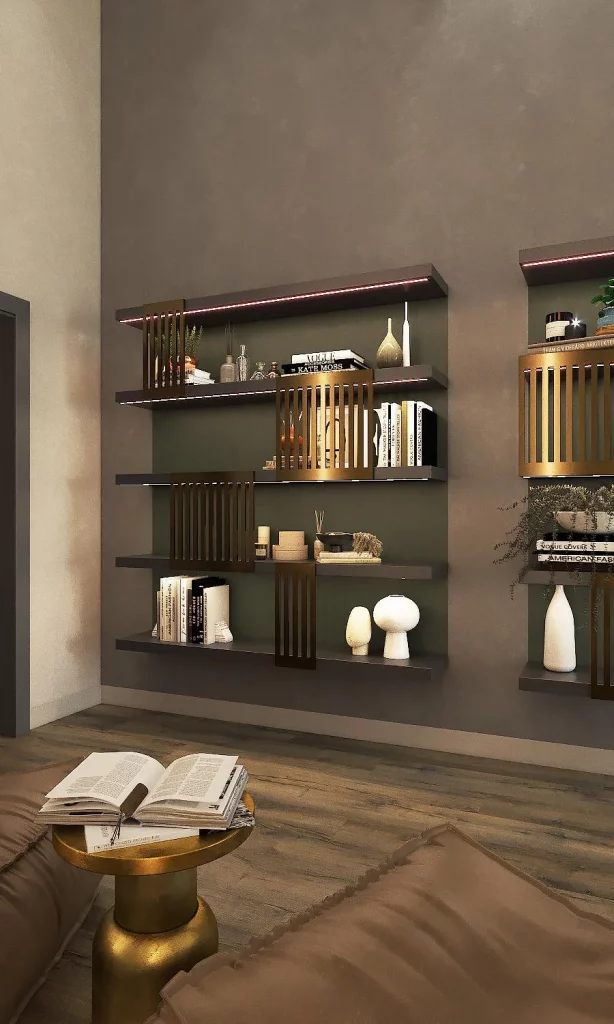
I think the slatted elements are what make this shelving particularly distinctive. They provide separation without completely closing off the shelves, so the arrangement still feels open. The repeated horizontal shelves create order, while the vertical dividers introduce contrast and keep the long lines from appearing monotonous.
If I were adapting this idea, I would use the dividers strategically rather than placing them between every item. They work best as visual punctuation. I would also repeat the warm lighting consistently across the shelves, as shown here, and keep a mixture of books and sculptural objects so the display feels functional as well as decorative.
Wall-Mounted Shelves Above a Compact Home Workspace
The final image shows a small workspace with a white desk positioned against a pale wall and two simple white floating shelves mounted above it. The upper shelf holds a potted plant, candles, framed pieces, and small decorative objects, while the lower shelf contains containers filled with pens and art supplies along with more framed pictures. A dark desk lamp sits on the work surface, and two chairs with green seats and patterned backs are placed in front of the desk. Part of a large round wall clock is visible on the right.
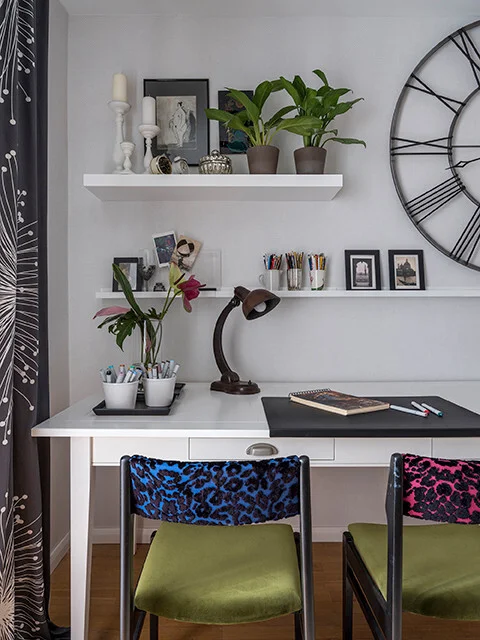
I like how these shelves make the workspace feel organized while keeping the desk itself relatively open. The lower shelf provides easy access to frequently used supplies, whereas the upper shelf works more as a decorative display. The combination of greenery, artwork, containers, and practical stationery gives the space personality without sacrificing its purpose as a work area.
For a similar setup, I would separate decorative and functional objects by shelf, just as this image does. That makes it easier to keep everyday supplies accessible while allowing the upper level to remain visually calm. I also think the white shelves are a smart choice for this composition because they blend with the wall and let the desk accessories, artwork, plants, and patterned chairs provide the character.
Suspended Wood Shelves With Natural Character
I love the relaxed character of these four dark wood shelves suspended vertically by thin metal cables. The shelves have irregular, organic edges and visible wood grain, giving the arrangement a handmade appearance. Each level holds a small selection of objects, including ceramic bowls, books, a framed picture, a piece of driftwood, and a small potted plant. The restrained arrangement allows the shelves themselves to remain the main visual feature while the neutral wall keeps the composition easy to appreciate.
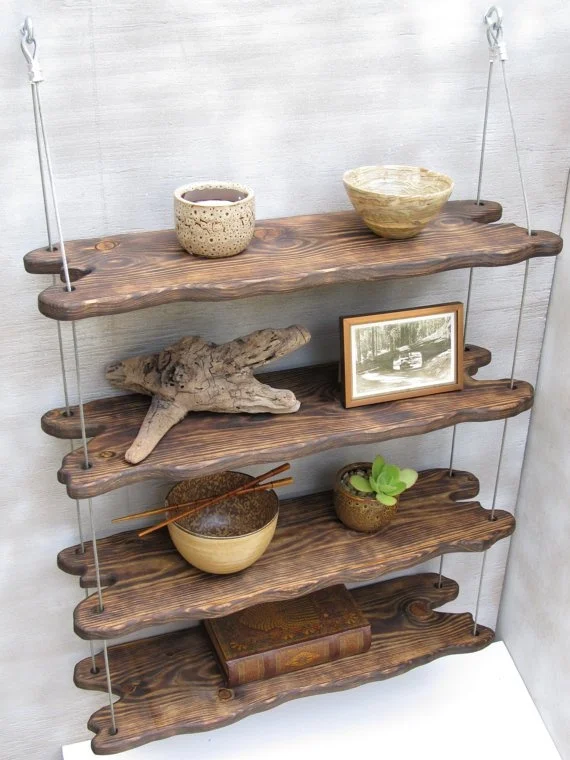
What works especially well for me is the combination of open storage and generous spacing. The cables make the shelves appear visually lighter than a conventional bookcase, while the four levels provide enough room to separate different types of objects. I also like that the styling does not fill every available inch. Leaving some empty space around the bowls, books, and decorative pieces prevents the display from looking crowded.
When I recreate this kind of look, I would pay close attention to the balance between the shelf widths and the objects placed on them. The irregular edges already provide plenty of visual interest, so I would keep the accessories relatively simple. I also find that mixing horizontal books with taller objects and sculptural pieces helps create a display that feels collected rather than overly arranged.
Built-In Shelving Around a Compact Home Office
This bedroom workspace uses tall white shelving to frame a compact desk and computer area. I notice multiple open compartments extending almost from floor to ceiling, with books and small decorative objects distributed throughout. A white desk sits between the shelving sections, while a black office chair provides contrast. Above the desk, a backlit world map adds a distinctive focal point, and the blue tones of the computer screen and bedding connect naturally with the illuminated artwork.
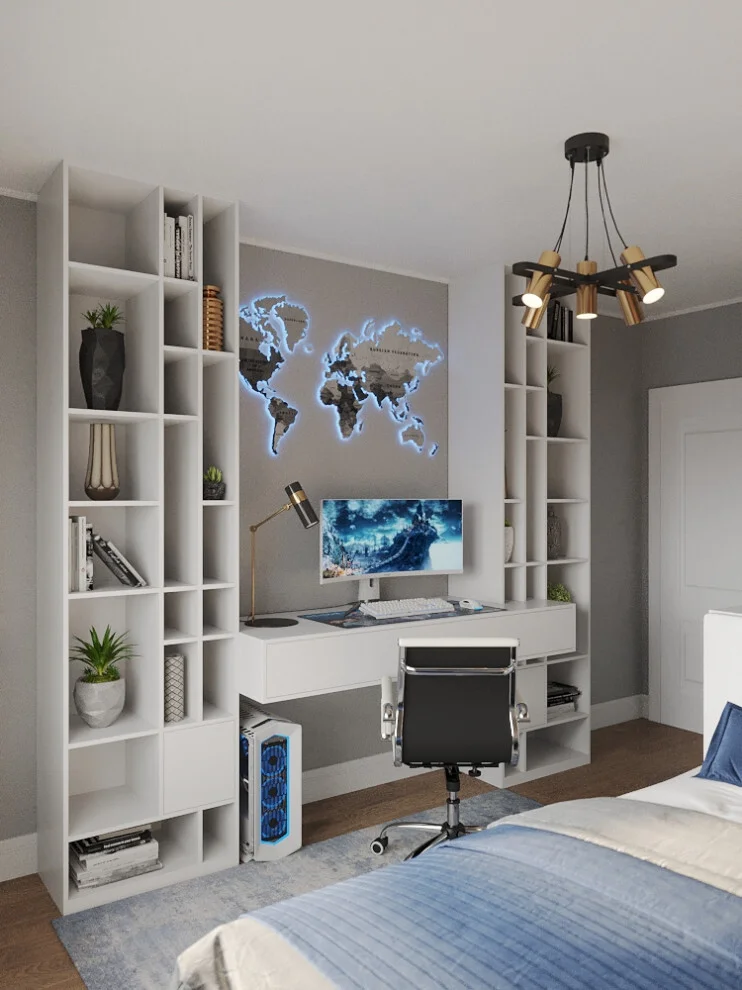
For me, the strongest feature is how efficiently the shelving defines the work zone without requiring a separate room. The open compartments provide storage and display space around the desk, while the lower sections offer practical places for larger items. Because the shelving is white, it visually blends with the desk and keeps the composition from feeling too heavy despite its considerable height.
I would use a similar approach when I wanted a home office to feel integrated into a bedroom. Rather than treating the shelves as an afterthought, I would make them part of the entire workstation composition. The image also reminds me that open shelving benefits from repetition: similar book arrangements and small objects placed at different heights can make a large wall of compartments feel intentional and organized.
Round Wall Shelf As a Sculptural Focal Point
I find this circular wall shelf particularly appealing because its unusual silhouette immediately attracts attention. The large round frame contains a horizontal shelf across the lower portion, creating a simple display area for stacked books, a small vase, and a few carefully chosen decorative pieces. The neutral wall, green upholstered chair, dark floor lamp, and brown curtains create a calm setting, allowing the circular shelf to stand out without competing with too many other shapes.
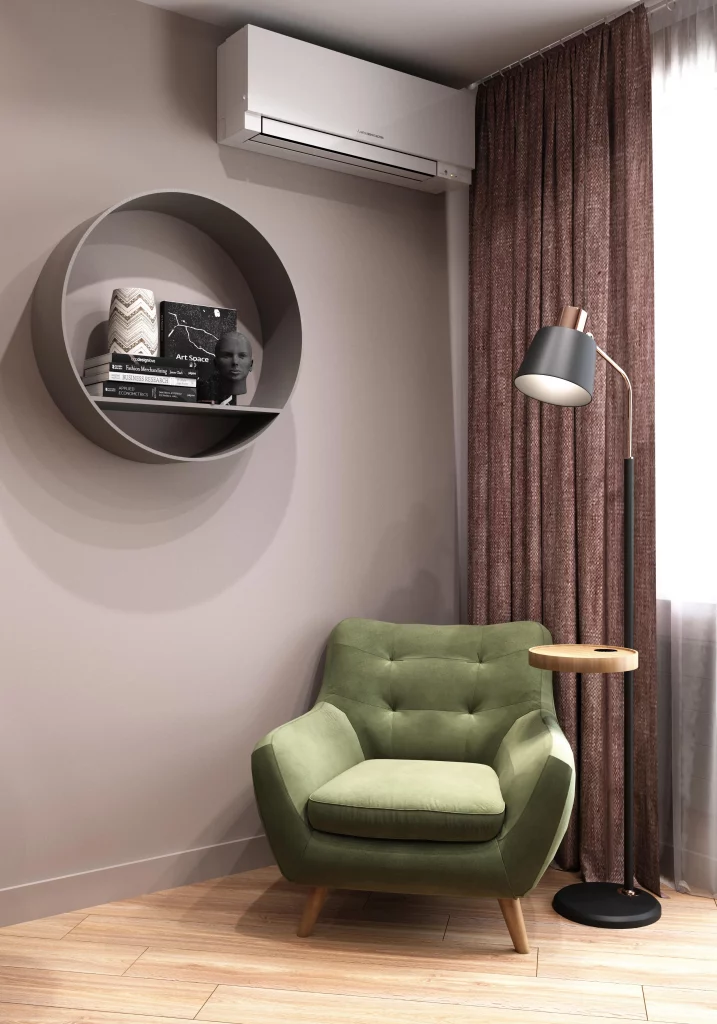
The curved outline gives this storage piece a completely different presence from a traditional rectangular shelf. I like how the circular frame becomes wall decoration in its own right while still providing useful space for books and accessories. Its compact footprint also makes the idea suitable for a reading corner or another small area where a full bookcase would feel excessive.
If I were styling a shelf like this, I would resist the temptation to fill the entire interior. The image works because the books and objects have room around them, allowing the shape of the shelf to remain visible. I would also use objects with different heights and silhouettes, as the combination of stacked books, a vessel, and a small artwork creates enough variation without making the display feel busy.
Slim Open Shelving For a Refined Bathroom Corner
Here, a narrow open shelving unit occupies a recessed corner of a bathroom, combining thin wood-toned shelves with a dark vertical metal frame. The shelves hold neatly arranged toiletries, folded items, books, containers, bowls, and small decorative accessories. Behind the unit, a vertical wood-toned panel contrasts with the pale marble-look surfaces, while the large arched opening beside it adds another strong architectural shape.
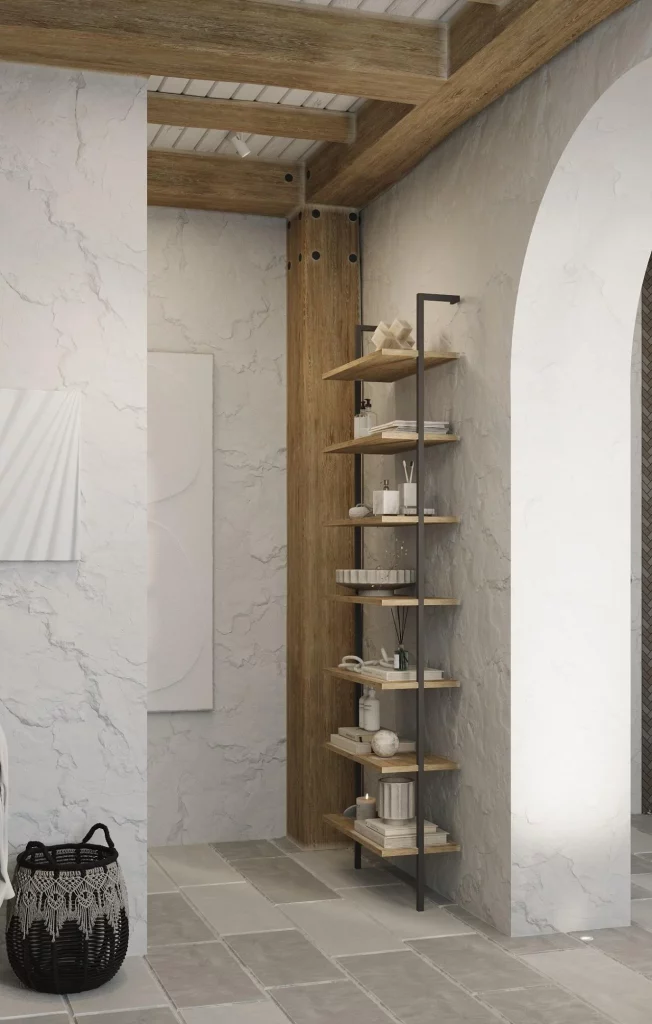
I think the slim proportions are what make this shelving solution so effective. Instead of taking over the bathroom, the unit uses otherwise limited vertical space. The open construction also makes the contents easy to see and reach, which is particularly useful for frequently used bathroom items. At the same time, the combination of dark metal and warm shelf tones adds definition against the pale surroundings.
For a similar result, I would keep the most frequently used objects at comfortable heights and reserve the less accessible upper shelves for decorative pieces or occasional-use items. I also like the way this example mixes functional containers with books and decorative objects. That combination prevents the shelving from looking like a purely utilitarian storage rack and gives the bathroom a more considered appearance.
Classic Bookcase Styling Above a Decorative Fireplace
This elegant composition combines a built-in bookshelf with a highly detailed fireplace surround. The shelving is filled primarily with books in soft neutral tones, interspersed with framed artwork, vessels, small sculptures, and other objects. Below it, the fireplace has an ornate pale surround and a dark tiled interior filled with candles. The dark wood floor and muted wall color create a warm backdrop for the entire arrangement.
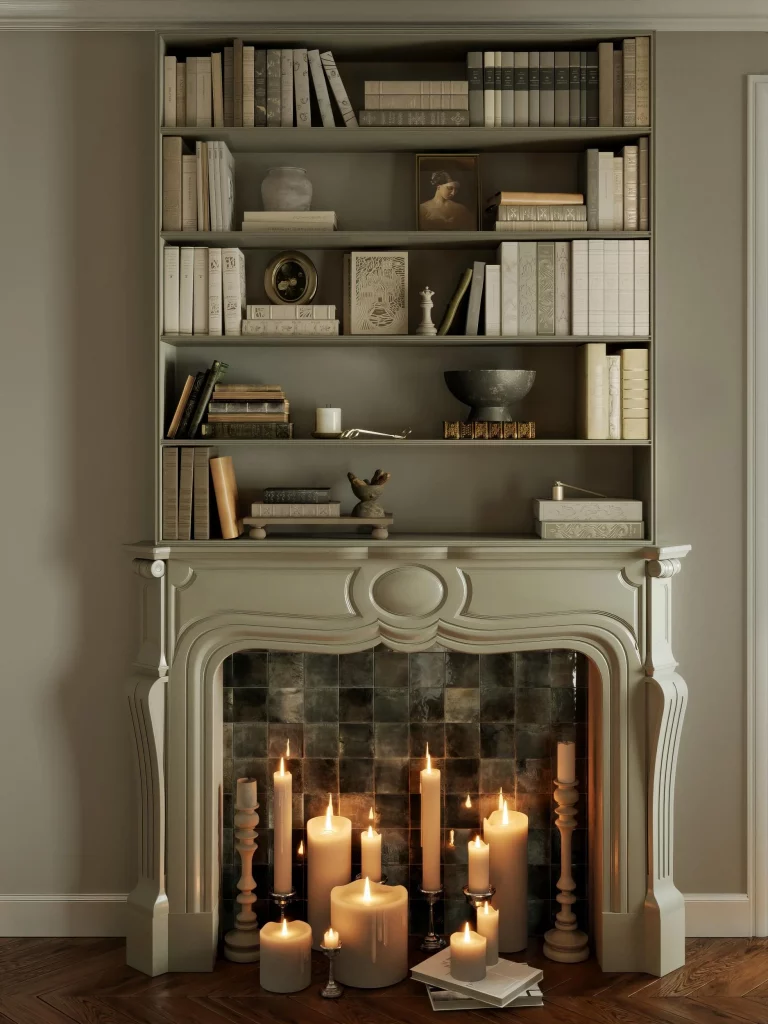
What I find most successful is the visual relationship between the shelves and the fireplace. The horizontal lines of the bookcase create order above the more decorative fireplace surround, while the repeated neutral shades keep the whole wall cohesive. The books are not arranged identically, either; some stand upright while others are stacked, creating small changes in rhythm across the shelves.
I would approach a display like this by treating the entire fireplace wall as one composition rather than styling the bookcase shelf by shelf in isolation. The image shows how books can become part of the decoration when their colors are coordinated with the room. I would also leave occasional open areas around decorative objects so the shelves have visual breathing room.
Window-Side Shelving Framing a Bright Reading Workspace
This inviting workspace places a desk directly beneath a large window, with tall open shelving units positioned on both sides. The shelving contains rows of books, while the central window brings abundant daylight into the room. A light-colored chair with wood-toned arms sits at the desk, and matching wood tones appear throughout the shelving, floor, ceiling beams, and window ledge. Soft fabric window shades filter the daylight without blocking the view completely.
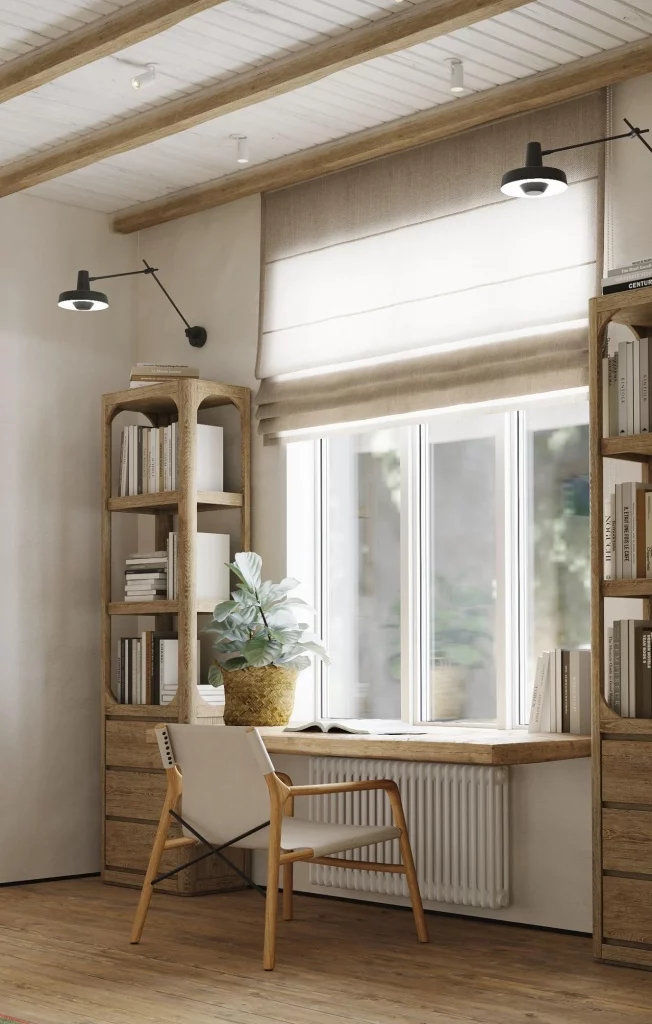
For me, this is a great example of combining storage with a pleasant working position. The shelving makes use of the vertical wall areas beside the window while leaving the central section open to natural light. The books are immediately accessible from the desk, and the open shelves prevent the workspace from feeling enclosed. The consistent material palette also helps connect the separate pieces into one visual arrangement.
I would take inspiration from this layout when designing a home office around an existing window. Rather than blocking the strongest source of daylight with tall storage, I would frame it from the sides as shown here. I also like the idea of using the window ledge as part of the workspace, because it visually connects the desk, shelving, and outside view into one continuous area.
Arched Rattan-Style Wall Shelf With Curved Detail
This wall-mounted shelf immediately stands out because of its rounded top and woven-looking structure. The warm tan frame contains several compact shelves filled with books, bowls, a small plant, framed artwork, candles, and simple decorative objects. The curved upper outline gives the piece a softer appearance than a conventional rectangular shelving unit, while the light wall behind it keeps the overall display fresh and uncluttered.
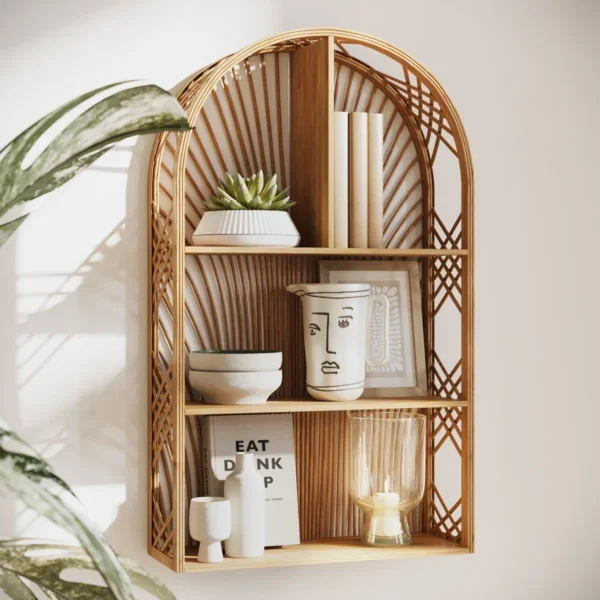
I like how much personality this single wall shelf adds without requiring a large amount of space. The vertical arrangement makes use of the wall rather than the floor, and the individual compartments provide enough separation to keep the small objects readable. The combination of books, ceramics, artwork, and greenery also gives the display variety while maintaining a consistent warm-toned palette.
When styling a compact shelf like this, I would avoid placing similarly sized objects on every level. The photograph shows why mixing books, bowls, artwork, and smaller pieces creates a more dynamic composition. I would also make sure that the curved outline remains clearly visible, because that distinctive shape is one of the strongest decorative features of the entire piece.
Geometric Freestanding Shelves Beside the Bed
This bedroom uses a tall, slender shelving structure with several triangular and angled compartments arranged vertically beside the bed. The shelves have a dark finish that contrasts with the pale wall, while black-and-white books are displayed inside the compartments. A compact bedside cabinet sits nearby, and a minimalist wall light provides illumination above the sleeping area. The arrangement makes a strong geometric statement without requiring a bulky bookcase.
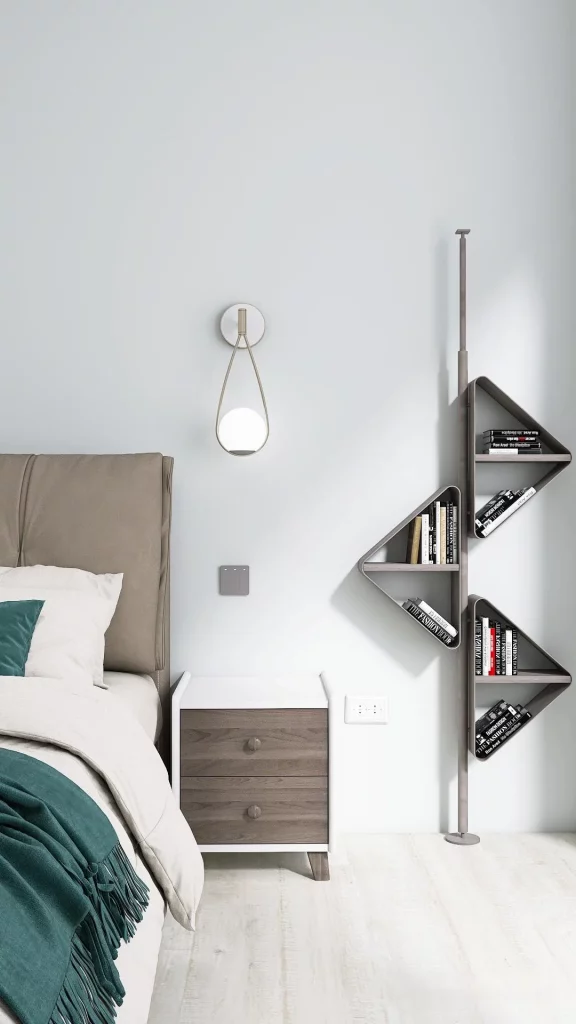
What appeals to me most is the way the shelving uses an otherwise narrow vertical area. The unusual triangular compartments provide storage while also functioning almost like wall sculpture. Because the shelves rise from floor level, they create a strong vertical line that visually organizes the empty wall beside the bed without overwhelming the relatively simple bedroom.
I would use this approach when I wanted practical book storage but did not want a traditional rectangular bookcase. The image shows that unusual shelf geometry can become a major design feature when the rest of the room remains restrained. I would also keep the contents relatively coordinated, as the consistent black-and-white book covers help emphasize the architectural shape of the shelving.
Pink Built-In Shelving With an Integrated Desk
The final image takes a much more expressive approach, with a saturated pink built-in shelving unit surrounding a white desktop. Books are arranged in the open compartments, while a stack of books and a container holding writing tools sit directly on the desk. Beside the shelving, patterned wall covering and two sculptural wall lights add further visual interest. A large window provides a nighttime city view, making the workspace feel both colorful and personal.
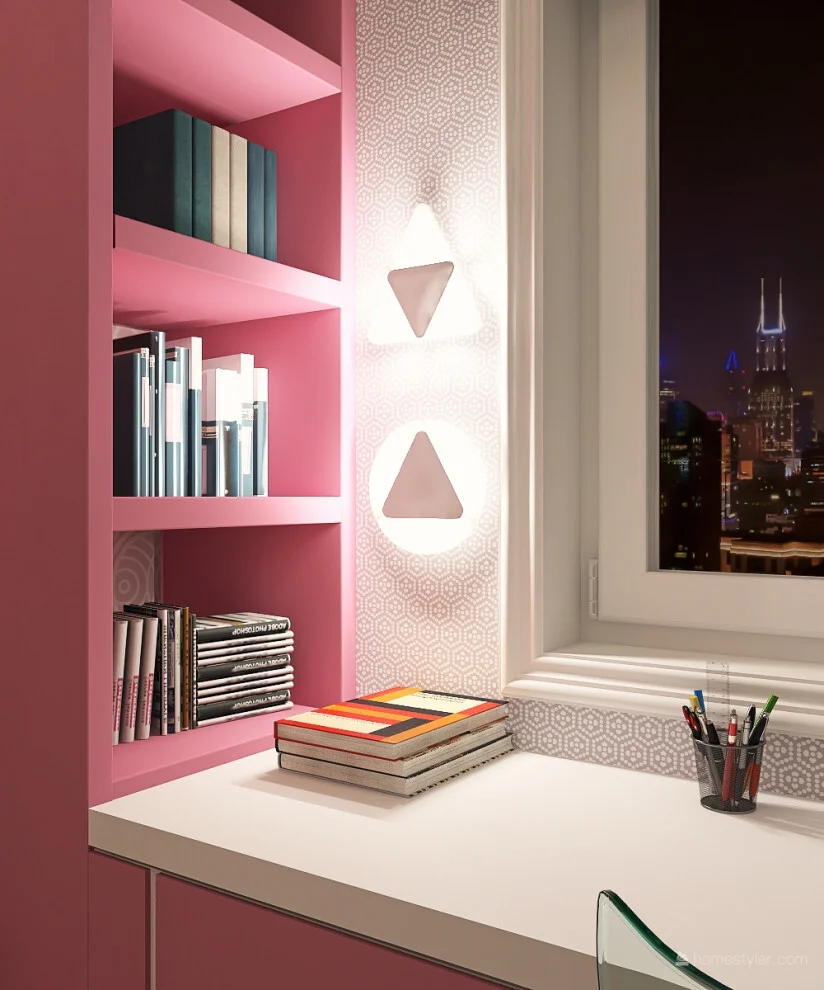
I especially like how the shelving and desk are designed as one continuous unit. Instead of treating storage and workspace as separate pieces, the built-in construction connects them visually and makes efficient use of the wall. The white desktop provides a clear working surface against the pink surroundings, while the books introduce smaller variations in color and texture without distracting from the strong cabinetry.
For me, this image is a reminder that shelving can be an opportunity to introduce personality into a functional room. If I were creating a similar workspace, I would let the shelving color establish the main visual identity and keep the desk surface relatively organized. The open compartments are ideal for books and selected objects, while the generous desktop leaves enough room for actual work rather than turning the entire area into a display.
Bright Built-In Shelves Framed by a Window-Filled Corridor
I love the serene feeling of this narrow, light-filled corridor, where a built-in shelving unit occupies the far end of the space. The shelves are finished in white and arranged across several open levels above closed lower cabinets. Each shelf displays orchids and other delicate greenery in white, black, gray, and transparent containers, creating a soft arrangement of pink, white, and green against the pale background. Large windows run along the right side, while additional glazed openings appear on the left, filling the corridor with natural light. The pale patterned flooring adds a subtle texture without competing with the display.
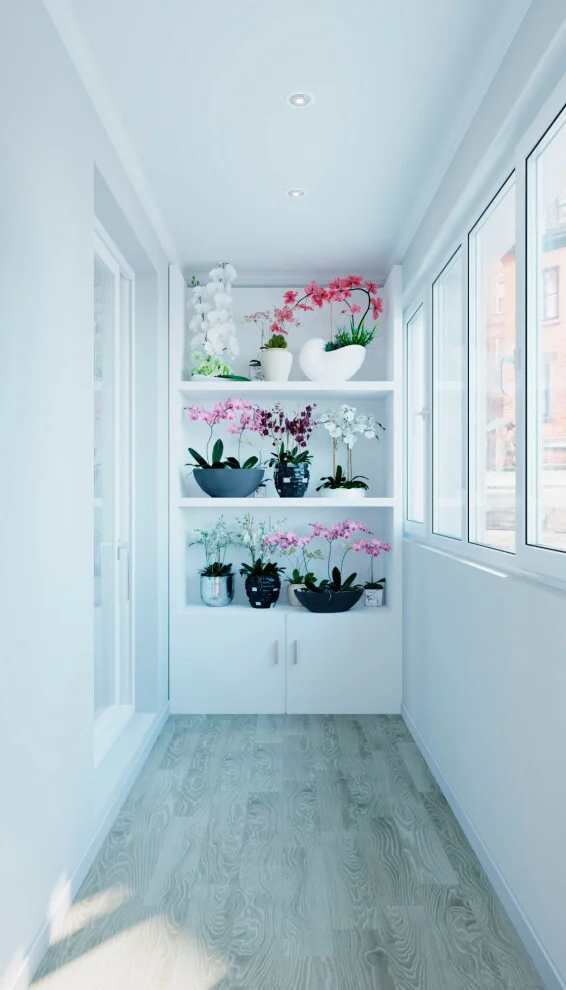
What makes this shelving arrangement work so well for me is the way it gives a very narrow passage a clear visual destination. Instead of leaving the end of the corridor empty, the shelving turns it into a carefully styled focal point. The combination of open shelves and closed storage below is particularly practical because decorative objects can remain visible while less attractive everyday items can be kept behind the cabinet doors. The symmetrical white cabinetry also blends naturally into the architecture rather than making the hallway feel crowded.
I would approach a similar space by keeping the shelving color close to the surrounding walls and allowing the displayed objects to provide most of the visual interest. Here, the orchids are repeated across different levels, but their varying sizes and colors keep the arrangement from looking overly rigid. I also like the decision to leave some breathing room around the containers. That empty space is important in a narrow corridor because it keeps the display feeling light rather than overloaded.
Illuminated Arched Niches for an Elegant Decorative Wall
This interior takes shelving in a much more architectural direction. Several recessed niches with rounded tops are built directly into a deep taupe-gray wall, and concealed lighting outlines their interiors with a warm glow. Dark shelves divide some of the niches, while others are left more open for books, vessels, candles, and small decorative pieces. To the left, an ornate framed mirror and a dark wooden chest add a traditional decorative presence, creating an interesting contrast with the clean geometry of the illuminated shelving. The dark wood flooring reinforces the warm, intimate atmosphere.
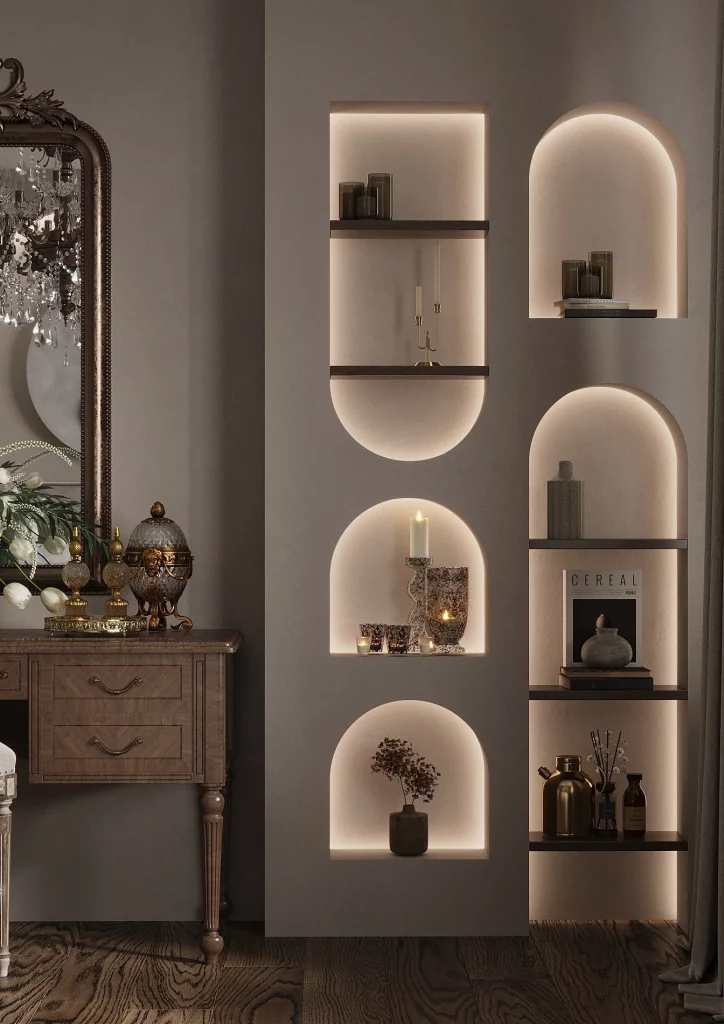
For me, the strongest feature is the way the shelving becomes part of the wall itself. These are not simply shelves attached to a surface; the curved recesses create a layered architectural effect and give every object its own visual setting. The integrated lighting is especially effective because it makes the display visible even within the darker color palette. Small collections look more intentional when they are separated into individual niches, and the shelving provides both organization and decoration without requiring a large freestanding cabinet.
If I were recreating this idea, I would focus first on the shape of the niches and the lighting rather than on filling them with numerous accessories. The photograph shows how just a few carefully positioned objects can look sophisticated when they are surrounded by illuminated negative space. I also appreciate the mixture of vertical and horizontal pieces, such as vessels, books, and candles, because it gives the display a natural rhythm while maintaining the calm character of the room.
Curved Floating Shelves Above a Streamlined Wooden Sideboard
This bright room demonstrates how a simple wall can become much more expressive with sculptural floating shelves. Two dark-edged shelves extend horizontally above a long, streamlined wooden sideboard, but instead of following a straight line, their surfaces gently rise and dip in flowing curves. The shelves hold a restrained collection of glass vessels, greenery, a diffuser, and a few small objects. Sunlight enters from the nearby window and creates strong natural shadows across the white wall, while the pale wood of the sideboard keeps the overall composition warm and understated.
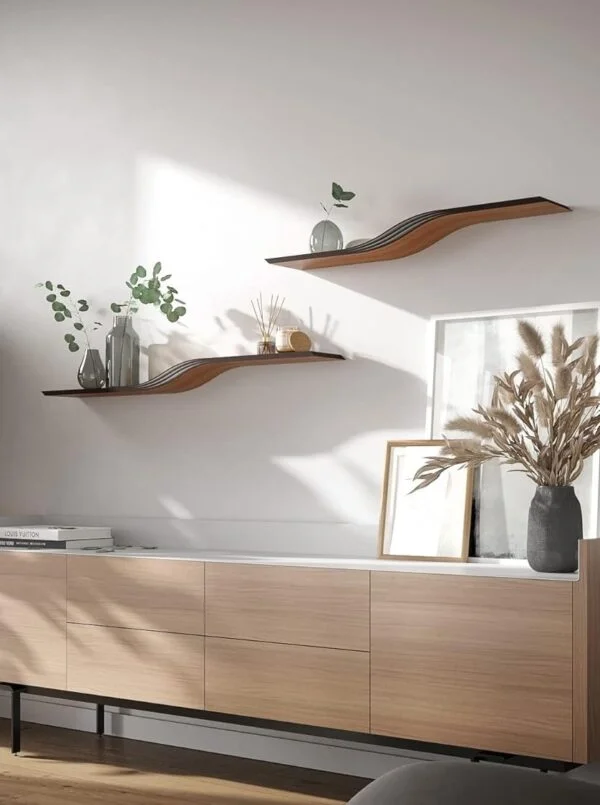
I find the relationship between the curved shelves and the straight sideboard particularly successful. The cabinet provides a strong horizontal foundation, while the shelves introduce movement above it. Because the wall remains mostly open, the unusual shelf shapes are easy to appreciate. At the same time, the display space is genuinely useful: the shelves hold small decorative items while the sideboard provides a broad surface for larger objects and framed pieces.
This is the kind of shelving idea I would choose when I want personality without covering an entire wall. The sculptural silhouette does much of the decorating work, so the styling can remain relatively simple. I would also take inspiration from the way the objects are spaced apart rather than arranged edge to edge. That approach allows the unusual shape of each shelf to remain visible and keeps the composition visually calm.
Dark Built-In Shelving Combined With a Dedicated Home Office
Here, shelving and a workstation are combined into one substantial built-in composition. A dark brown desk stretches between two sets of drawers, while an extensive open shelving framework rises above it. The shelves contain books arranged both vertically and horizontally, framed photographs, small sculptures, decorative vessels, and circular objects. A computer sits directly on the desk, with a keyboard and other small office items below it. A cushioned upholstered chair faces the workspace, and a tall speaker stands to the right. The warm wood floor adds depth beneath the dark furniture.
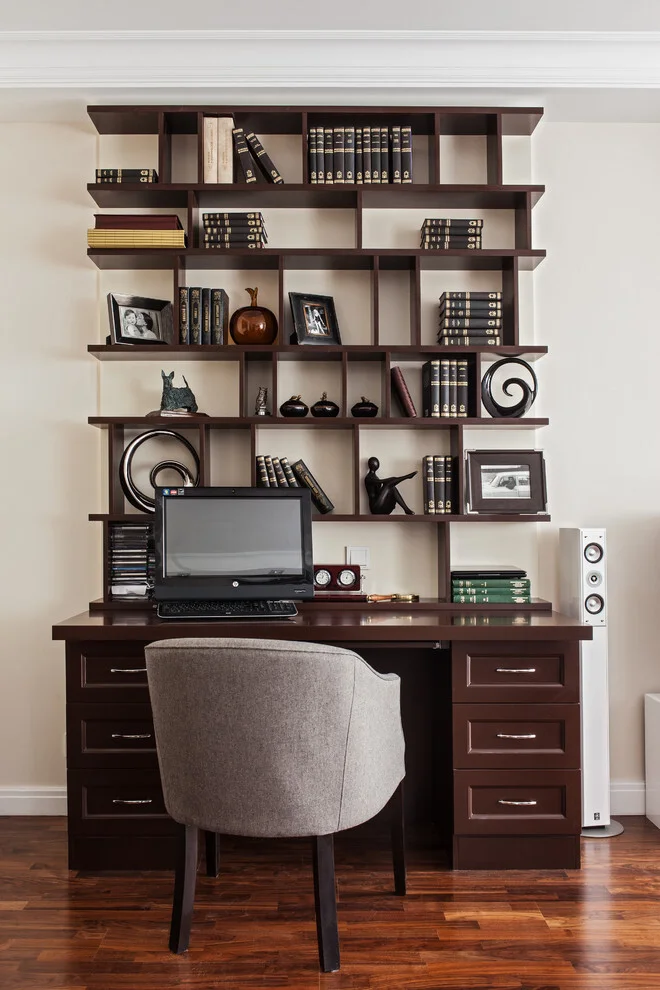
I like this arrangement because it treats storage and work space as one coordinated unit. The drawers provide practical closed storage for office necessities, while the open shelving keeps frequently seen books and personal objects accessible. The varied shelf compartments also prevent the large unit from looking like one solid block. Instead, the different proportions create a display that feels collected and personal while still providing a very substantial amount of storage.
When I look at a setup like this, I am reminded that shelves do not have to be purely decorative to contribute to the character of a room. The books, photographs, sculptures, and objects make the office feel lived-in rather than anonymous. I would keep a similar balance between useful and decorative pieces, allowing some compartments to remain partially empty. The open areas visible in this photograph are just as important as the objects because they give the entire arrangement room to breathe.
Soft Gray Shelving With Integrated Lighting Beside a Cozy Sofa
This compact living area uses a tall shelving unit as part of a textured feature wall. Narrow vertical panels cover the wall behind a low gray sectional sofa, with slim illuminated gaps adding vertical lines of light. To the right, a floor-to-ceiling shelving unit contains books, small vessels, framed pictures, decorative figures, and several small potted plants. Each compartment has its own soft lighting, giving the objects a subtle glow. The neutral gray, beige, and pale wood tones create a quiet atmosphere, while the low seating keeps the room visually grounded.
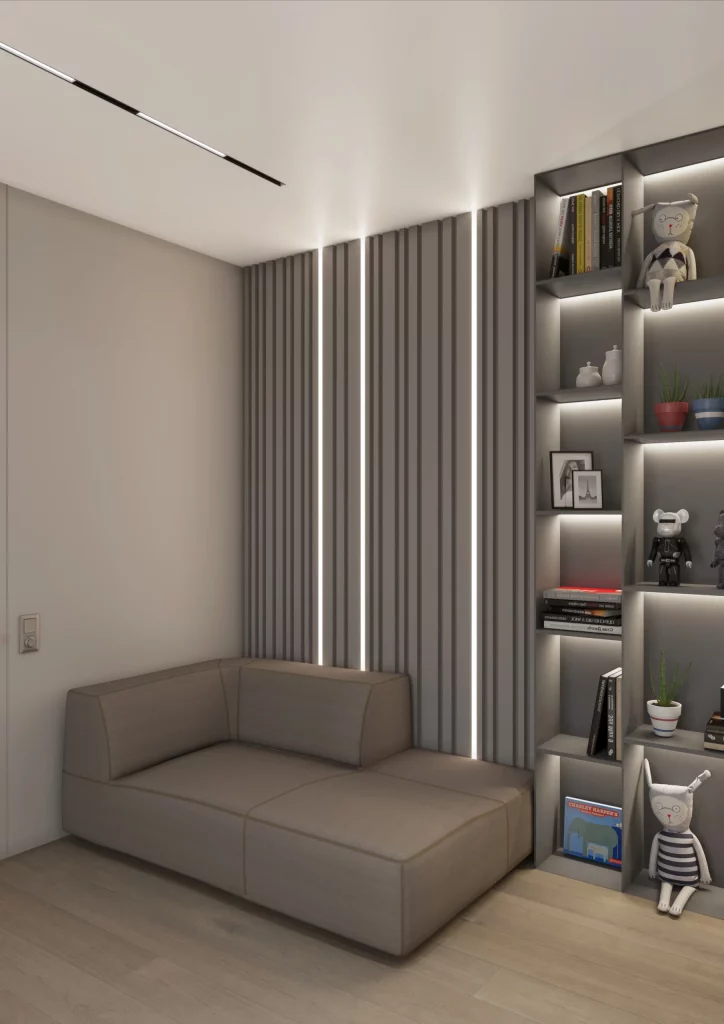
For me, the clever part of this design is how the shelving combines display space with atmospheric lighting. Instead of relying on one decorative centerpiece, the individual compartments create a series of smaller visual moments. The shelving also makes good use of vertical wall space without requiring additional floor furniture. Placing it directly beside the sofa keeps books and personal objects close at hand while visually connecting the storage unit to the seating area.
I would use this photograph as inspiration for anyone trying to make a small seating space feel more complete without filling it with furniture. The narrow vertical wall treatment and illuminated shelves create height, while the low sofa maintains an open feeling near the floor. I particularly like the restrained palette because the lighting and objects become the main sources of variation. Keeping accessories selectively arranged would preserve the same calm effect.
Playful Curved Storage With an Integrated Climbing Wall
This children’s space combines storage, display, and play in one highly distinctive arrangement. A tall shelving unit has a dramatic curved wooden frame that sweeps upward along one side, creating an unusual silhouette around open shelves and mustard-colored storage fronts. Books, boxes, small objects, and numbered baskets occupy the compartments. Immediately beside it is a white climbing wall covered with colorful climbing holds arranged across a perforated surface. An arched opening on the left reveals a large window and a view outside, while the gray carpet keeps the room comfortable and practical.
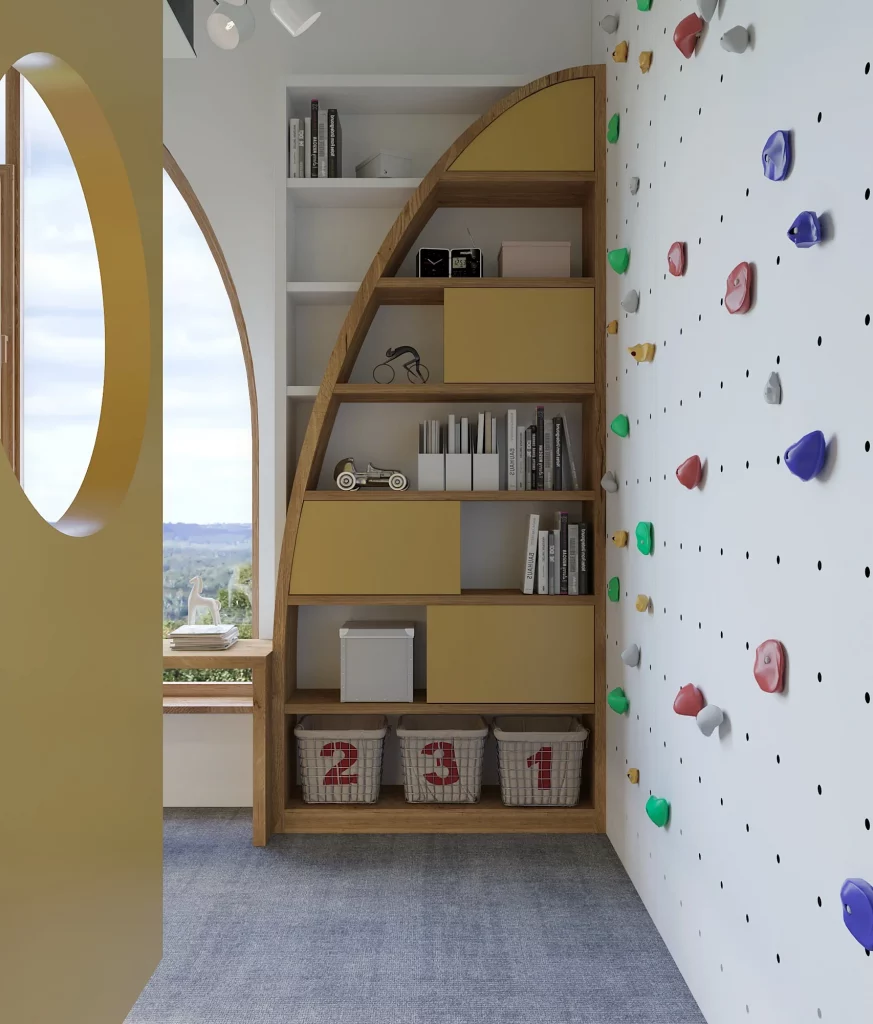
I think this is an excellent example of shelving being designed around the way a room is actually used. The storage unit is not isolated from the child’s activities; it sits directly beside the climbing wall and becomes part of a larger play and organization zone. The open compartments make books and belongings easy to reach, while the baskets at the bottom offer a straightforward way to gather smaller items. The curved frame also gives a functional storage piece a playful architectural character.
If I were borrowing this idea for a family space, I would focus on combining accessible storage with one strong visual feature rather than trying to reproduce every element. The photograph shows how useful baskets, closed compartments, and open shelves can coexist in a single unit. I also like the restrained mustard color on the cabinet fronts because it adds definition without overwhelming the white and wood palette. The climbing wall demonstrates how storage can be positioned alongside recreational features without making the space feel disconnected.
Warm Floating Shelves Framed by Vertical Wood Slats
This dining or living area features a symmetrical wall display built around a central panel of narrow vertical wood slats. Floating shelves are positioned on both sides at different heights, creating a balanced but not perfectly mirrored composition. Each shelf is illuminated from underneath and styled with small potted greenery, ceramic vessels, a framed botanical image, and a few decorative pieces. A larger shelf runs across the lower portion of the arrangement, while a window on the left brings in daylight and a glimpse of the adjoining room appears on the right.
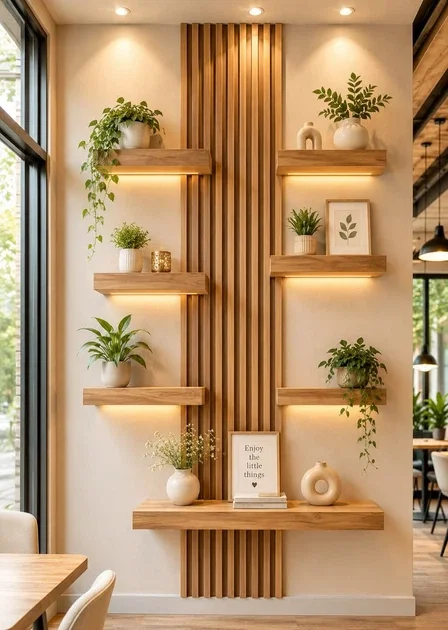
What I find especially appealing is the combination of the vertical slatted center and horizontal shelves. The slats draw the eye upward, while the shelves stretch across the wall and create practical display surfaces. Under-shelf lighting gives the objects definition and adds a warm layer of illumination. Because the shelving is relatively shallow and remains close to the wall, the arrangement creates a strong feature without taking up floor space.
For me, this is a good lesson in using repetition to create cohesion. The same warm wood tone appears throughout the shelving and central wall treatment, while the greenery and small ceramic pieces introduce variation. I would keep the styling similarly edited if using this concept at home. Repeating a few related materials and shapes can make several separate shelves feel like one intentional composition.
Marble Recessed Shower Shelves With Soft Linear Lighting
This bathroom shows how shelving can be integrated directly into a shower wall. Three horizontal recessed shelves are carved into a wall finished in white marble-look surfaces with prominent gray veining. Each niche is illuminated from above or along its interior edge, highlighting the bottles and containers placed on the shelves. The lower portion of the shower remains open, while a glass shower enclosure is visible on the left. The floor features a repeating diamond pattern in white and warm brown, adding a geometric contrast to the organic marble veining.
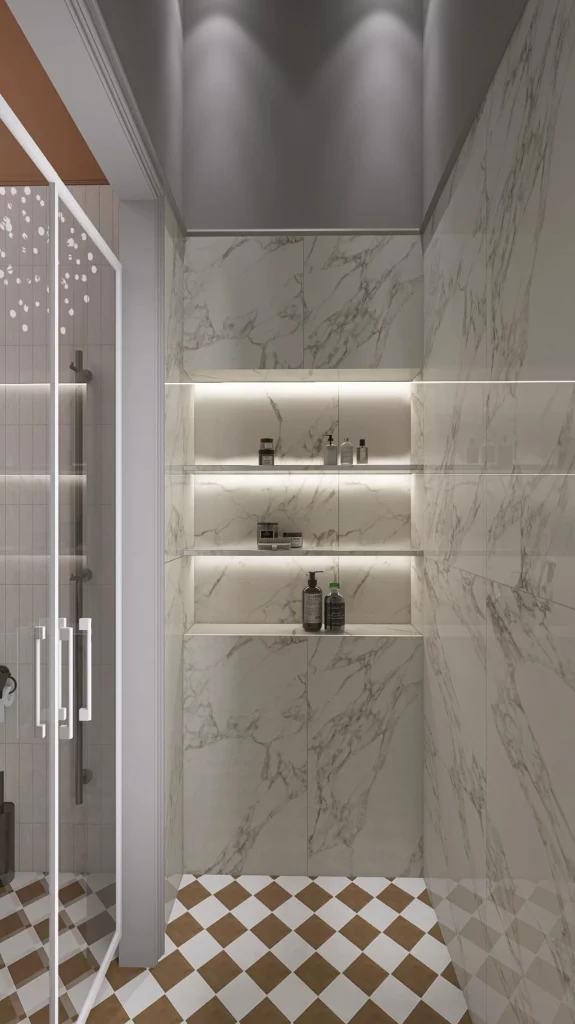
I particularly like how practical the recessed shelving is here because it provides storage without projecting into the shower area. Bottles are grouped neatly across the illuminated levels, keeping everyday products accessible while maintaining the clean appearance of the walls. The continuous marble finish also makes the niches feel like an intentional part of the architecture rather than an added storage accessory. For a shower, this is one of the most space-conscious shelf arrangements in the collection.
The photograph also shows why lighting can be valuable even in a purely functional shelf. The illumination makes each level easier to see and gives the marble surfaces additional depth. If I were planning a similar arrangement, I would pay close attention to the proportions of the niches and keep the products relatively organized so the shelving continues to look clean. The patterned floor already provides visual interest, so the restrained styling of the shelves feels appropriate.
Slim Illuminated Display Towers in a Refined Bedroom
This bedroom uses two tall, narrow shelving towers with dark frames and warm metallic edging. Each vertical unit is divided into several illuminated compartments containing books, ceramic vessels, decorative objects, and small framed pieces. The shelving stands against a darker wall panel, while the center of the room remains open for a wall-mounted artwork. On the right, a compact floating vanity with a large rounded mirror continues the metallic detailing, and a bed with layered neutral bedding occupies the lower portion of the room. Warm wood flooring adds another natural element.
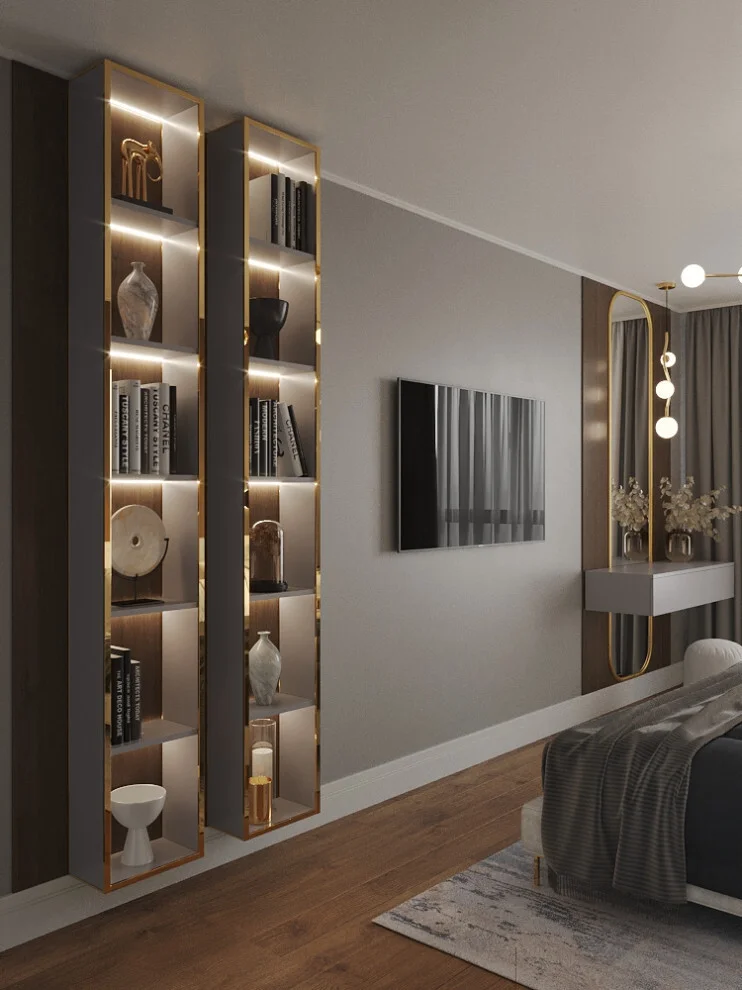
I like the restraint of these shelving towers because they add substantial storage and display space without taking over the bedroom. Their narrow proportions make use of vertical space, and the internal lighting draws attention to the objects without requiring additional lamps on the floor. The separate towers also leave the central wall visually open, allowing the artwork to remain an independent focal point. It is a useful arrangement when a bedroom needs storage but should still feel spacious.
From my perspective, the success comes from coordinating the shelving with the rest of the room instead of treating it as a separate feature. The metallic borders echo the nearby mirror, while the dark interiors complement the darker wall treatment. I would follow the same principle when styling similar shelves: repeat finishes that already appear elsewhere in the room and choose objects that support the existing palette rather than introducing too many unrelated colors.
Open Wooden Display Shelving With a Cozy Decorative Collection
The final image presents a large open shelving unit made from thick dark wood frames and horizontal shelves. The irregular rectangular compartments contain candles, small vessels, greenery, decorative objects, glowing salt-lamp-style pieces, and colorful cushions. A smaller framed compartment sits toward the center, creating an overlapping geometric effect within the larger structure. The shelving stands behind a cozy seating area with patterned cushions and a low surface in front, while the warm lighting and rich wood create a relaxed, intimate atmosphere.
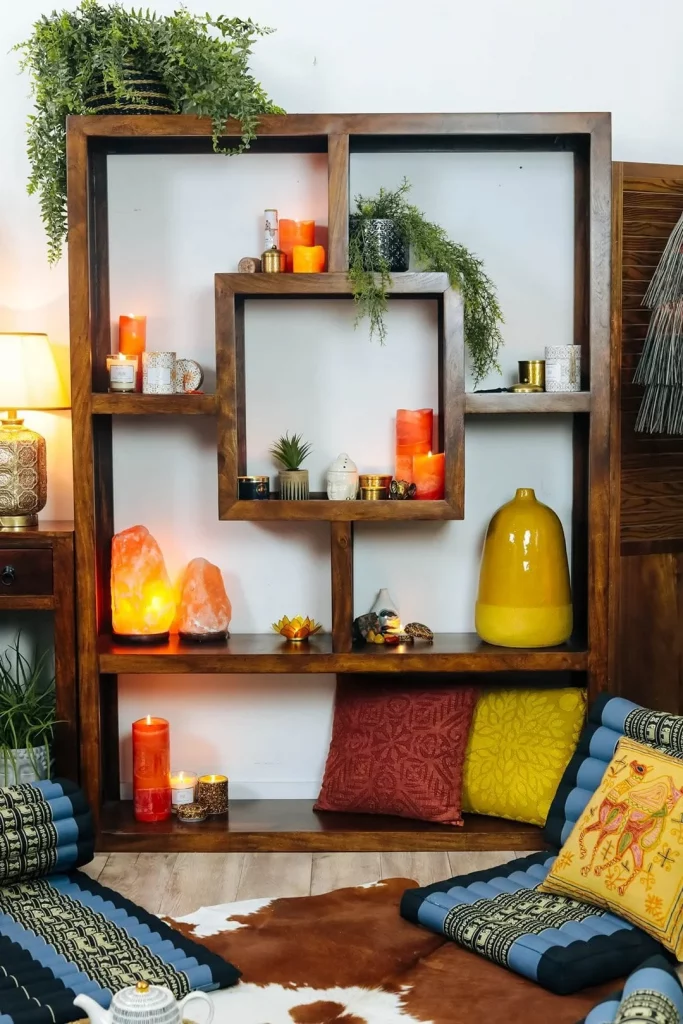
For me, this shelving arrangement feels especially personal because it mixes objects with different sizes, colors, and functions rather than following a strict display formula. The open structure also works as a visual backdrop for the seating area, giving the room a defined focal wall. Larger objects anchor some compartments, while candles, small containers, and greenery fill others. The combination of open space and densely styled sections keeps the unit from feeling completely uniform.
I would take inspiration from this example when creating a shelf display that is meant to feel collected over time. Rather than making every compartment identical, I would vary the scale of objects while repeating a few colors or materials to keep everything connected. The photograph also shows how lighting can transform ordinary decorative pieces, especially when candles and glowing objects are incorporated into the arrangement. The result is a shelf that functions as both storage and atmosphere.
Round Floating Shelf That Turns a Quiet Corner Into a Styled Reading Spot
I love how this compact corner combines a sculptural round wall shelf with a simple white lounge chair, creating a small but complete styling moment. The shelf has a thin dark wood-colored circular frame divided by white horizontal and vertical supports, while books and small potted plants fill only a few compartments. Below it, the white chair with natural wood-toned legs is softened by a fluffy throw and a pink patterned cushion, while a small round side table holds another potted plant and a magazine. The white wall and warm wood floor keep the whole arrangement light and inviting.
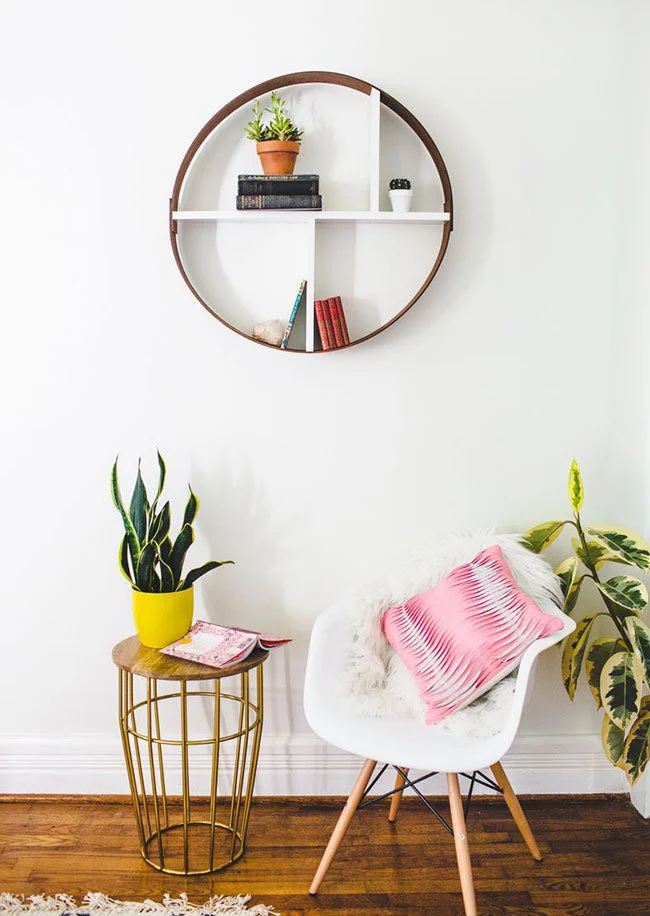
What makes this setup especially successful to me is the balance between open space and carefully chosen objects. The circular shelf provides visual character without taking over the wall, and the limited number of books and accessories keeps its compartments from looking crowded. I also like the relationship between the shelf and the furniture underneath it: the round table echoes the shelf’s curved outline, while the chair creates a comfortable place to actually enjoy the books displayed above.
When I style a small shelf, I usually find that leaving some compartments partially empty makes the entire arrangement look more intentional. Here, the books are positioned in small groups rather than packed across every section, and the plants add height and texture without overwhelming the composition. The restrained palette of white, brown, green, and pink also gives the corner a cheerful personality while remaining visually calm.
For a similar effect, I would keep the wall mostly open and treat the shelf as the main decorative feature. A few favorite books, one or two small objects, and greenery are enough to recreate the relaxed feeling shown here without turning a small seating area into a storage zone.
A Playful Geometric Bookshelf With Colorful Individual Compartments
This shelving arrangement immediately stands out because it is designed as a large sculptural composition rather than a conventional rectangular bookcase. Multiple angular compartments connect to form an irregular structure across the wall, with white frames surrounding sections accented in pale blue, green, yellow, and pink. Books are arranged throughout the openings, while a few framed pieces, decorative objects, and small toys add personality. The unusual silhouette makes the shelving itself the dominant feature of the room.
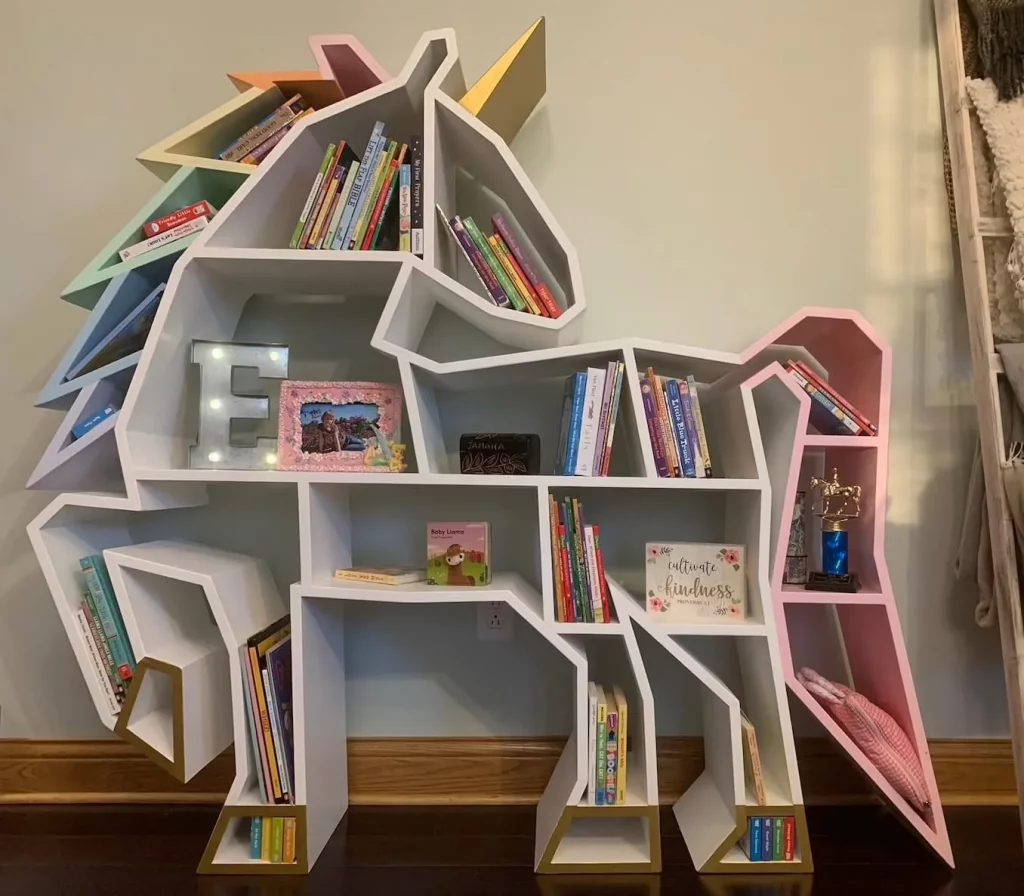
I find this approach particularly effective for a space where storage needs to feel decorative. Instead of hiding the books behind doors, the open compartments make the collection part of the room’s visual identity. The different shapes also create natural zones for organizing books and objects, while the colored interiors help distinguish individual sections without requiring additional labels or containers.
From my perspective, the key to making an unconventional bookcase like this work is restraint in the objects placed inside it. The shelving already has plenty of visual movement, so the books and accessories do not need to be arranged in an elaborate way. I would let the architectural shape provide most of the drama and use the contents to add small moments of color and character.
I also like how the lower compartments extend toward the floor, giving the entire structure a grounded appearance. For a similar project, I would plan the shape around the available wall first and then decide what needs to be stored inside each opening. That keeps the design practical instead of creating a sculptural shelf that looks impressive but lacks useful storage.
A Suspended Live-Edge Shelf for an Airy Bedroom Corner
Here, a single thick slab with an irregular natural edge is suspended from the ceiling by light-colored ropes. The shelf holds only a small stack of books and a narrow glass container with delicate white blooms, leaving most of the surface visible. It hangs beside a bright window and above the edge of a bed, creating a simple decorative feature without filling the wall with cabinetry.
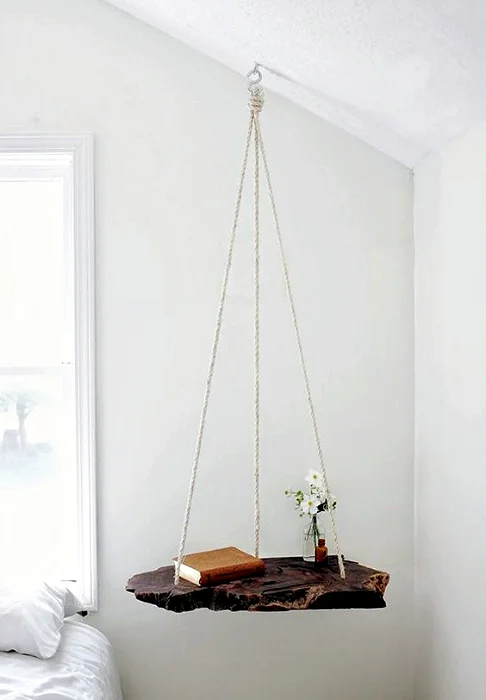
What I find most appealing is how little this shelf needs to make an impression. The irregular edge of the slab provides visual interest, while the ropes create a sense of lightness because there are no visible brackets beneath the surface. It also offers a useful little platform for books and small decorative pieces without introducing a large storage unit into the room.
I would consider this kind of suspended shelf especially useful when the goal is to keep a bedroom feeling visually open. The design takes advantage of vertical space while occupying very little apparent floor area. I also like that the styling remains minimal: the books and small vessel are enough to establish a purpose without making the shelf feel busy.
If recreating this idea, I would keep the surface intentionally edited and allow the irregular edge to remain visible. The strongest feature here is the shelf itself, so covering it with too many objects would hide exactly what makes the arrangement distinctive.
Built-In Window Nook With Open Shelving and a Hanging Hammock
This compact gray-toned nook combines several functions within a tightly organized area. A tall built-in shelving unit occupies the left side, with warm wood-colored shelves holding yellow pots, books, a framed artwork, a sculptural dark vase, and a few small accessories. Beside it, a deep window seat sits beneath large windows with horizontal blinds, while a fabric hammock hangs diagonally across the space. Gray and yellow cushions add small color accents against the otherwise muted palette.
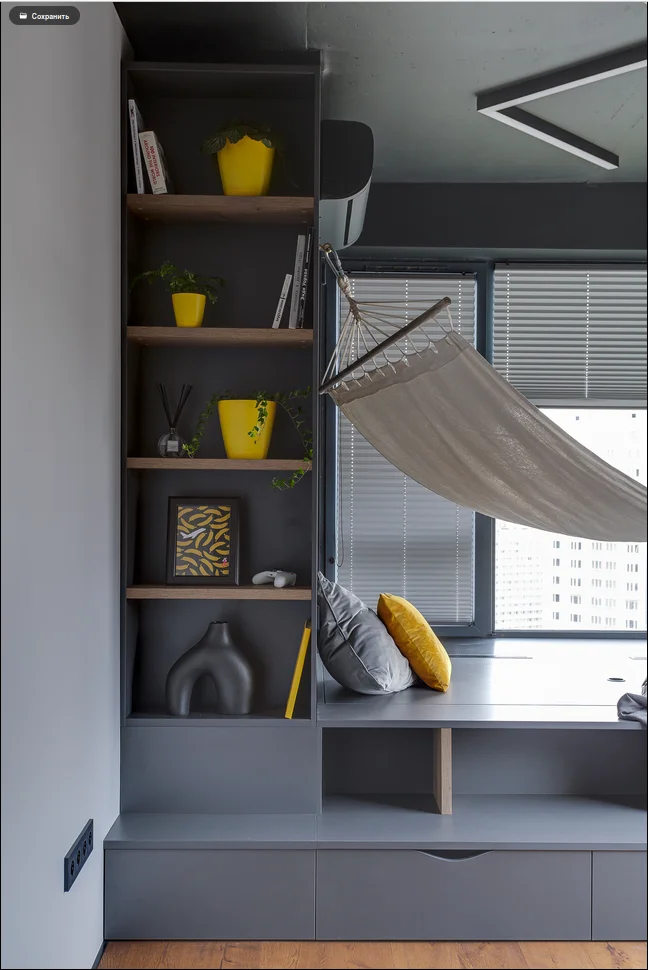
I think this is a clever use of a narrow area because the shelving, seating, and window are treated as one coordinated zone. The built-in storage makes use of vertical wall space, while the window seat provides a practical surface for sitting or relaxing. The hammock adds another distinct way to use the nook without requiring a large additional piece of furniture on the floor.
The contrast between the dark gray cabinetry and the yellow containers is particularly effective to me. The repeated yellow accents give the shelving a visual thread, while the wood-toned shelf surfaces prevent the darker unit from feeling completely flat. I would use this same principle in a small space: repeat one or two visible accents across different shelves instead of decorating every compartment differently.
Another detail worth borrowing is the decision to leave some shelf areas relatively open. The books, framed piece, vase, and small pots have enough breathing room around them to remain individually visible. In a compact built-in, that negative space is just as important as the storage itself.
Softly Illuminated Built-In Shelving in a Serene Child’s Room
This child’s room features a large white built-in shelving unit with a symmetrical grid of open compartments, warm integrated lighting, drawers, and closed storage at the bottom. Each illuminated section contains a carefully selected mix of books, framed illustrations, soft toys, baskets, and small decorative objects. The shelving stands beside a wall-mounted television and connects visually with the white desk area, while the pale flooring and neutral furnishings keep the room calm and cohesive.
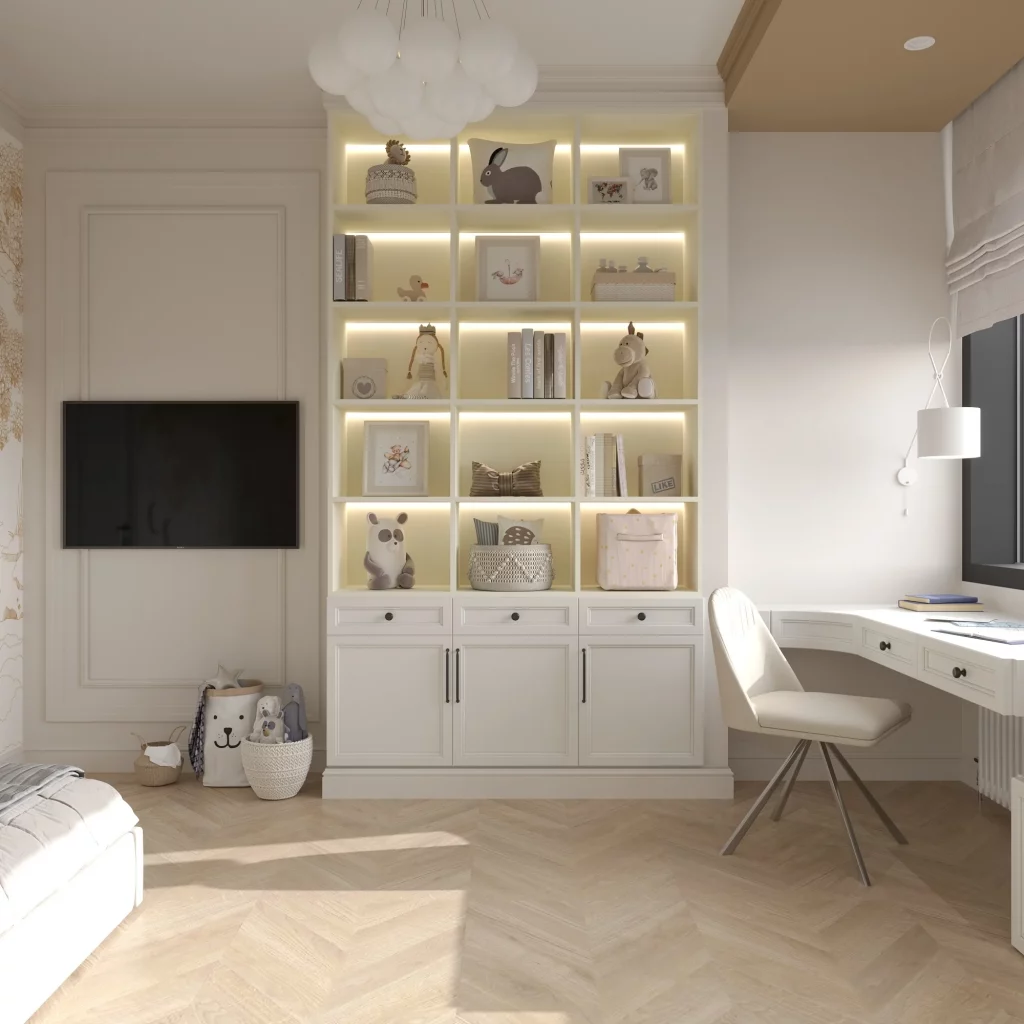
I particularly like how the shelving manages to feel decorative while still providing substantial storage. The lower drawers and cabinets can accommodate less display-friendly belongings, while the open compartments reserve space for items worth seeing. The warm lighting also gives each niche a soft glow, making the shelving feel like part of the room’s atmosphere rather than simply a storage wall.
In my experience, this type of built-in works beautifully when a room needs to serve several purposes at once. The shelving organizes books and toys, creates a focal point, and helps connect the television wall with the study area. The repeated rectangular compartments also bring order to the many small objects that naturally accumulate in a child’s space.
I would preserve the restrained arrangement shown here rather than filling every compartment to capacity. The neutral palette makes the individual toys and illustrations stand out, and the lighting gives even simple objects more presence. The result feels organized without becoming overly formal.
Marble-Effect Floating Shelves With Integrated Accent Lighting
This living room uses four slim floating shelves mounted against a textured vertical wall in a warm brown tone. Each shelf has a pale marble-effect surface and concealed-looking lighting underneath, creating a soft illuminated line across the wall. Books, small bowls, framed pieces, and sculptural objects are arranged with plenty of space between them. Below, a large neutral sofa and a simple wood-toned coffee table reinforce the warm, understated palette.
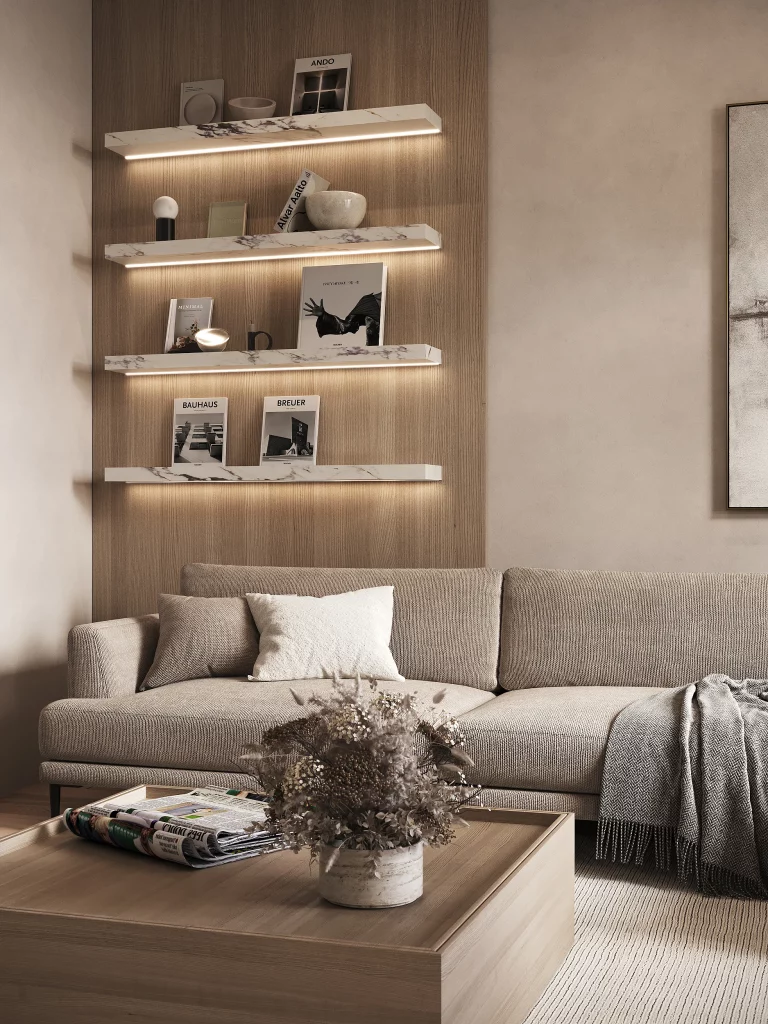
To me, the strongest feature is the relationship between the shelving and the lighting. The shelves are visually thin, but the illumination underneath each one gives them depth and makes the objects appear carefully presented. Because the sofa sits directly below the arrangement, the shelves also function as a vertical focal point for the seating area without requiring a large piece of artwork.
I would use this idea when I wanted open shelving to feel more architectural and less like an afterthought. The repeated horizontal lines establish order, while the warm light emphasizes the texture behind them. The limited number of objects also allows each piece to have its own visual space, which is particularly effective in a neutral room.
One finishing principle I would take from this design is consistency. The shelves share the same material treatment and lighting approach, so even though the objects change from level to level, the overall composition remains unified. I would keep that consistency if adapting the idea to another room.
Petite Balcony Shelves Framed by a Cozy Pink Seating Nook
This narrow enclosed balcony transforms a small vertical wall into a decorative display area. Two slim white floating shelves extend from the wall, holding several potted plants, including trailing greenery and a taller orchid-like arrangement with pink blossoms. A large circular wall detail sits behind the shelves, while a compact pink upholstered ottoman fills the lower part of the nook. A patterned blue, white, and pink throw adds another layer of texture, and the windows with horizontal blinds overlook a city scene.
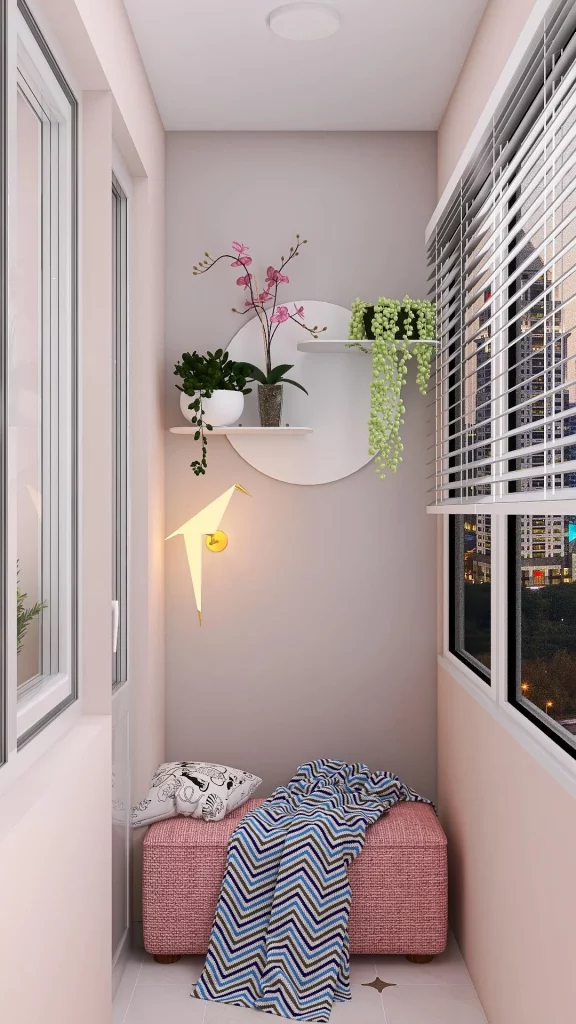
I like how the shelving makes use of the wall without interfering with the limited floor area. In a narrow balcony, every inch matters, and these shallow shelves provide display space while leaving the center of the nook open. The plants also create height and movement, particularly where the trailing greenery drops downward from the upper shelf.
For me, the color coordination is what makes this little corner feel intentional. The pale pink walls and ottoman relate naturally to the pink blossoms and parts of the throw, while the green foliage introduces a fresh contrast. The circular wall element gives the arrangement another geometric layer without competing with the shelving.
If I were recreating this mood, I would keep the shelves narrow and use a small number of objects with different heights. The image shows that a tiny nook does not need a lot of furniture or decoration to feel complete. A carefully arranged vertical display can provide most of the character.
Open Bathroom Shelving Framing a Sculptural Arched Mirror
This bathroom combines a large arched mirror with an open shelving tower finished in a warm wood tone. The mirror dominates the vanity wall and is surrounded by a pale stone surface with distinctive dark and brown veining. On the right, multiple shelves hold neatly arranged bottles, containers, small vessels, and decorative pieces. A floating vanity with a white vessel sink sits below the mirror, accompanied by folded white towels and understated countertop accessories.
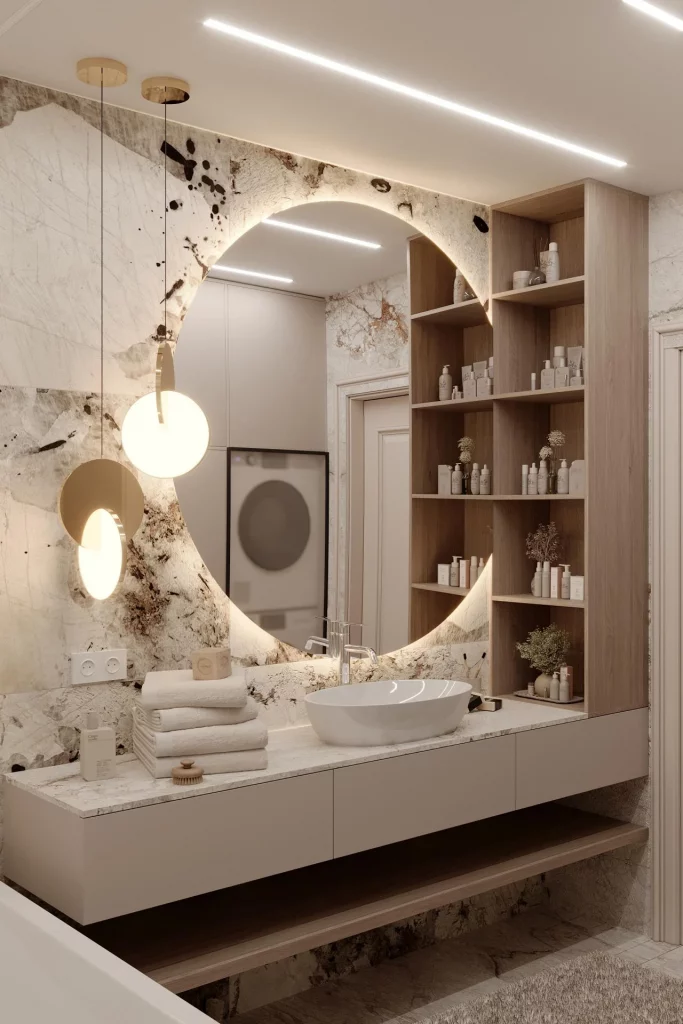
I think the open shelving is especially effective here because it brings practical bathroom storage into the composition without interrupting the large mirror. Everyday bottles and containers are grouped across the shelves, while the open structure keeps them accessible. The wood finish also adds warmth beside the pale stone surfaces, preventing the room from feeling visually cold.
The lighting deserves attention too. The illuminated edge around the arched mirror and the linear ceiling lights create a layered glow across the vanity area. I would consider this a useful lesson for bathroom shelving: even when storage is functional, thoughtful lighting can make the entire wall feel more polished and deliberate.
What I would preserve most carefully is the balance between display and utility. The shelves contain practical-looking containers, but they are arranged in an orderly way alongside decorative objects. Keeping similar items grouped together and leaving some open shelf space would help maintain the calm, refined appearance shown here.
The right shelving can turn an ordinary wall into one of the most expressive features in a home. From sculptural built-ins and illuminated displays to simple floating shelves, these ideas show how storage can be both practical and beautiful. I love how thoughtful styling with books, artwork, plants, and decorative objects can make shelves feel personal without looking overcrowded. The best approach is to choose a design that complements your space while leaving enough room for everyday life. Which creative shelf idea was your favorite? Leave a comment and share the design you would love to try in your home.