
Your front yard is the first thing people see, and it sets the tone for your entire property. Whether you prefer a tidy, traditional look or something more relaxed and natural, thoughtful landscape design makes a real difference.
We have rounded up 35 front yard landscape design ideas to help you transform your curb appeal. From pathways and plantings to lighting and hardscaping, these real-world examples cover a range of styles and practical approaches you can adapt to your own home.
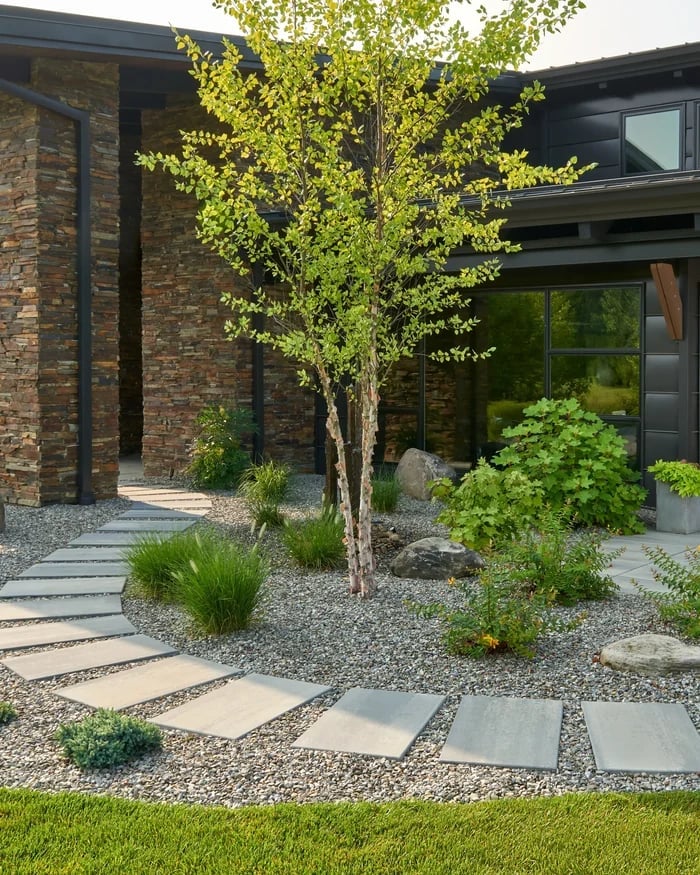
Modern Front Yard Pathway Through Gravel Garden
A stone paver pathway cuts through a bed of decorative gravel, creating a clear line of travel without blocking the view of the modern house behind it. The walkway curves just enough to feel natural, with a young tree anchoring the planting bed. Grey stone pavers sit flush with the gravel surface, so the path reads as part of the ground rather than a raised obstacle. That low profile is the key: when the hardscape stays at grade, the eye moves across the whole front yard instead of stopping at the path’s edge.
Geometric Driveway Pavers in a Modern Front Yard
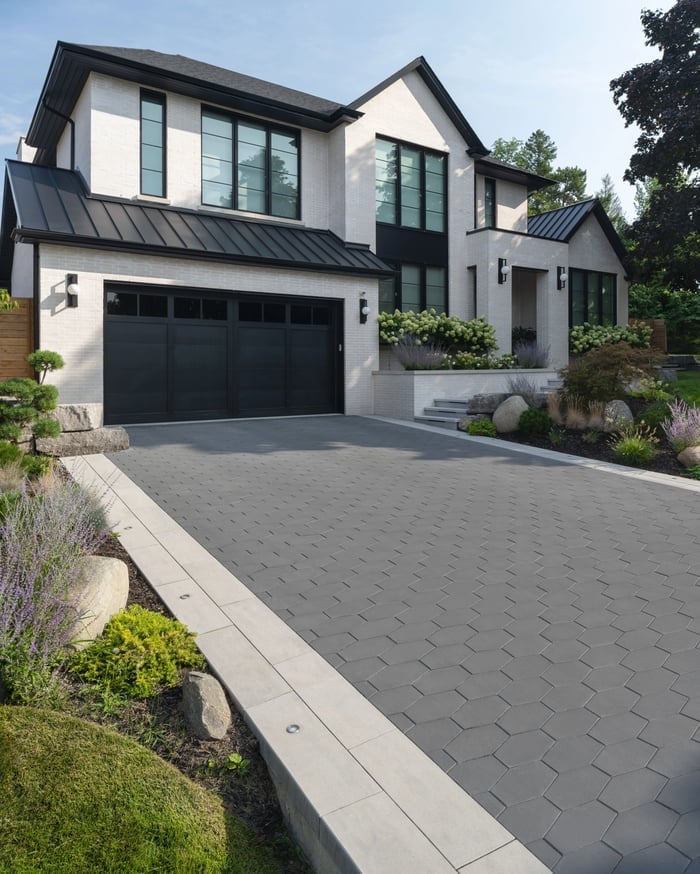
This driveway proves that a repetitive paver pattern can anchor the whole front yard. The geometric stone pavers run in a clean grid from the street to the house, with a rock garden on one side and low greenery breaking up the grey. The palette stays tight: grey, white, black, with purple accents from the plants. That limited color range is what makes the geometry work. More than three hardscape tones would compete with the pattern itself. For a similar effect in your own front yard, pick one paver shape and one neutral color, then repeat it consistently across the full width of the drive.
Contemporary Front Yard with Integrated Pathway Lighting
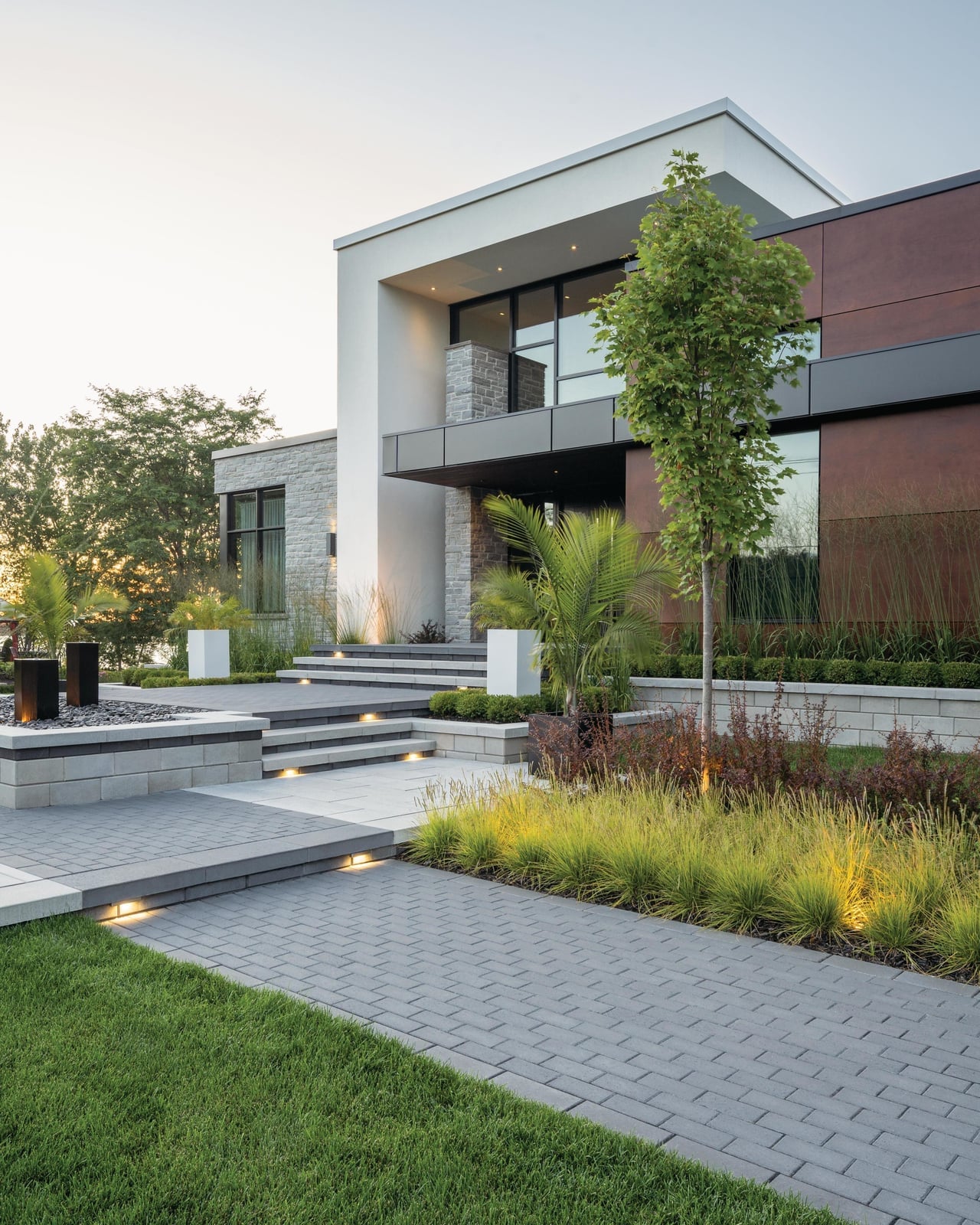
What does it take to make a front yard feel open after dark without flooding the house facade with light? This design tucks low-level fixtures directly into the pathway edges and planter borders, so the light comes from below rather than above. The light defines the walking surface and highlights the modern architecture.
The integrated lights are set into the concrete and stone pavers themselves, meaning there are no poles or visible fixtures breaking the clean lines. The palette stays grey, green, and white during the day; at dusk, the warm light becomes the dominant visual layer. For renters, a renter-safe swap is solar path lights placed flush against the paver edges. You get the same ground-level glow without any wiring or permanent installation.
Lush Cottage Garden Front Yard with Curving Stone Path
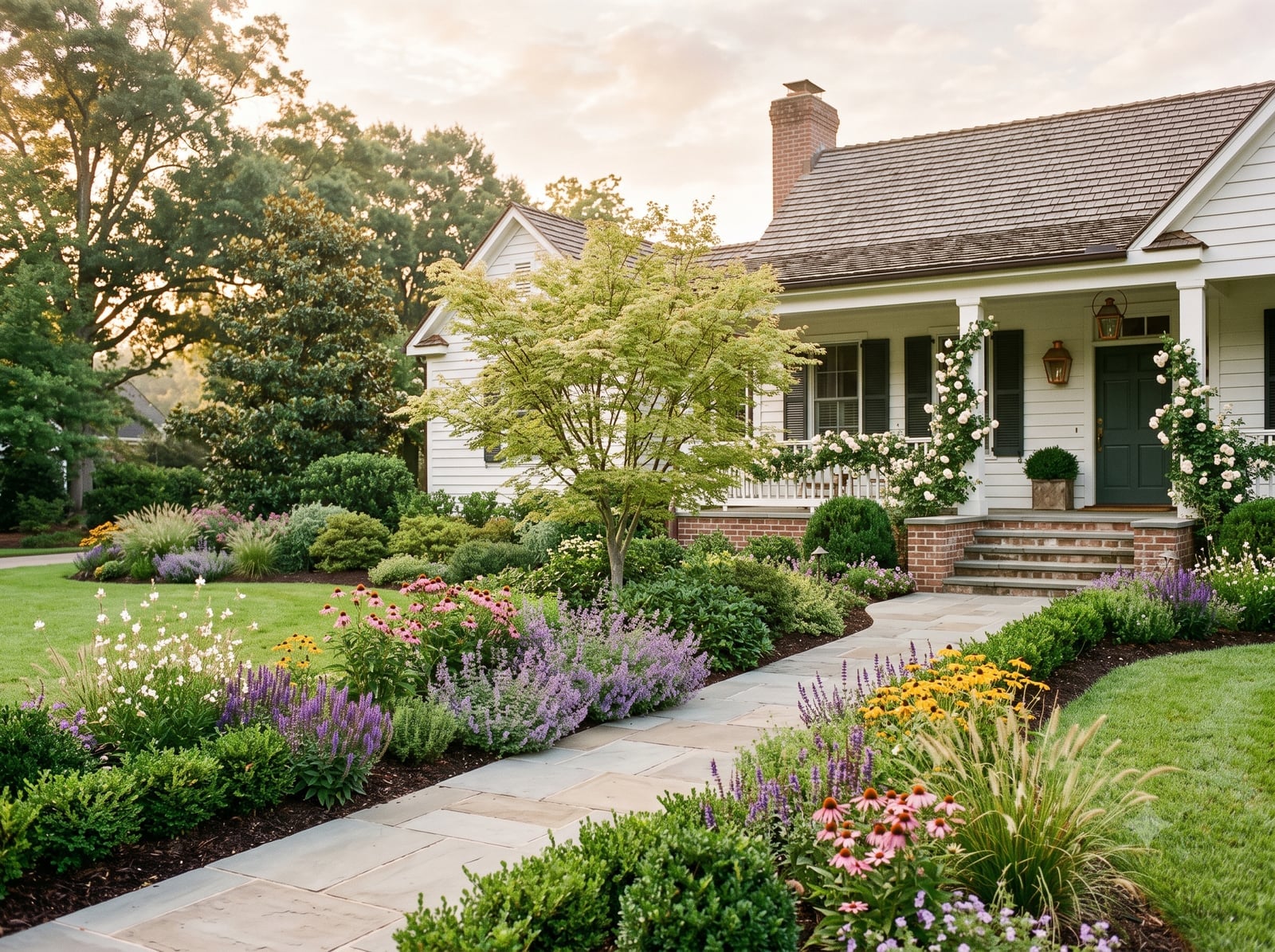
A curving stone path disappears into dense flowering beds, with pink, purple, yellow, and white blooms pressing close to the walking surface. The greenery is layered: low ground cover in front, mid-height shrubs behind, and taller plants near the porch. That stacking is what gives the garden its lush feel. One plant deep looks sparse; three layers deep looks established. The stone path stays dry underfoot because the beds drain into the soil instead of pooling on the walkway, a practical detail for any front yard with soft late-afternoon light.
Naturalistic Front Yard Pathway with Ornamental Grasses
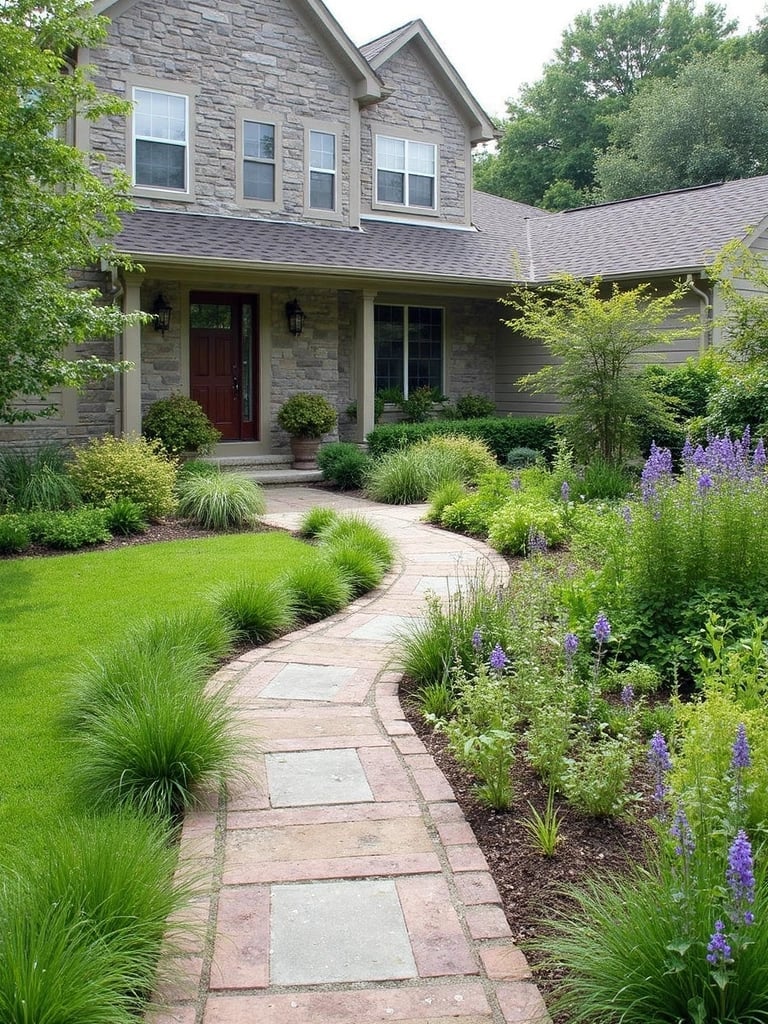
In a naturalistic front yard, use the pathway material to separate zones without blocking the view. A winding path made of alternating stone and brick sections cuts through a bed of ornamental grasses and flowering plants. The grasses add height and movement without needing constant trimming. The palette mixes greens, purples, beige, and grey, which keeps the planting looking intentional even when the flowers fade. The path is wide enough for two people to walk side by side, making the layout feel open.
Dense, Colorful Cottage Garden Flower Beds
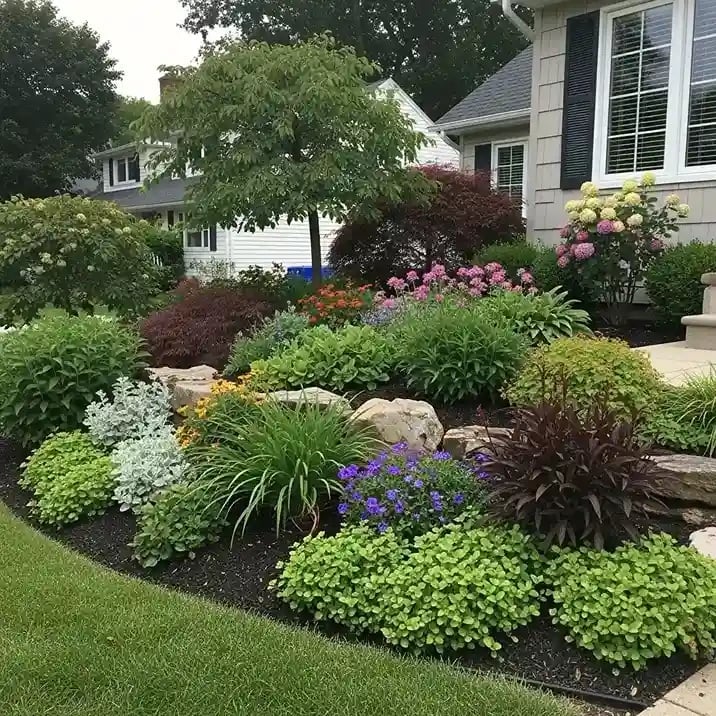
Skip the sparse look that needs constant editing. This front yard goes all in with layered flower beds packed close to the house foundation, blending green, pink, purple, red, and white. Ornamental trees and rocks break up the mass so it does not read as a single block of color. The palette is the anchor here: warm reds and pinks against cool purple and white keep the planting from feeling muddy. For a similar density, use three plants per square foot where the tag recommends one, and accept that some will crowd out others over the season.
Naturalistic Front Yard with Rustic Wooden Gate
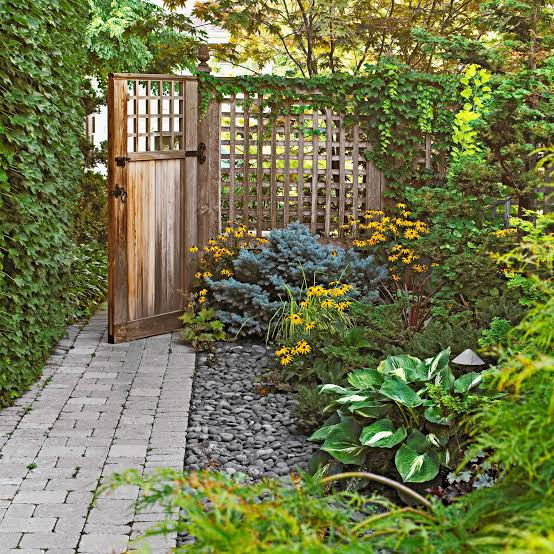
The wooden gate sits at the end of a stone path, framed by dense greenery and a lattice screen. It is not a grand entrance but a quiet transition, and that is the point. The gate becomes the focal point because the path leads the eye straight to it. A renter can borrow this logic without installing a fence: place a single tall planter or trellis at the far end of a walkway to draw the same visual line.
Stately Traditional Entryway with Manicured Boxwood
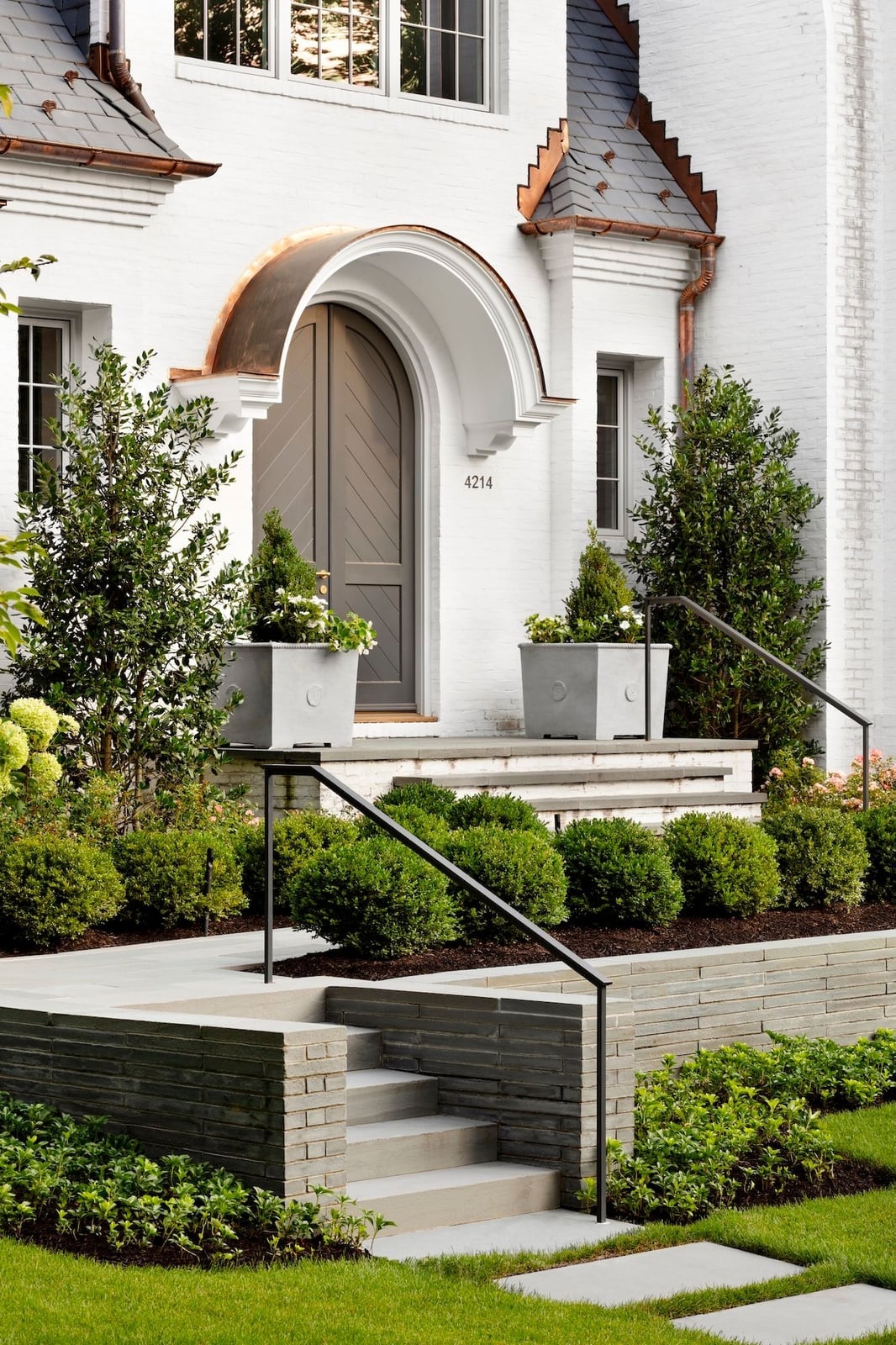
This entryway works because the scale of every piece matches. The arched doorway is wide, the stone planters are substantial, and the manicured boxwood shrubs are tall enough to flank the door without blocking it. The copper tones in the metal details keep the grey and white palette from turning cold. A common miss with traditional landscaping is undersizing the planters or shrubs, which makes the entry feel top-heavy. Here, the greenery sits at roughly half the door height, a ratio that holds the visual weight in balance.
Modern Xeriscape Front Yard with Concrete Pathway
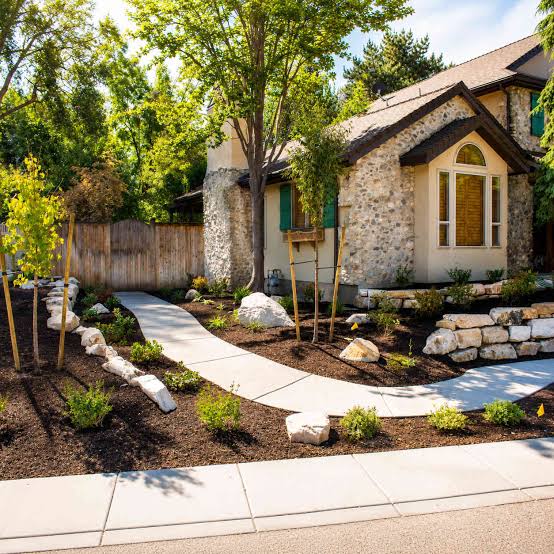
Can a concrete path and stacked stone wall hold up to foot traffic and weather without cracking or shifting? Yes, if the design accounts for movement. The curving concrete pathway here runs alongside a stacked stone retaining wall, with drought-tolerant plants softening the hard edges. The key to durability in xeriscape is the base layer: concrete paths need a compacted gravel sub-base at least four inches deep to prevent settling, and stone walls need a gravel trench behind them for drainage. Without that, freeze-thaw cycles will push the wall out of line within a few winters.
Modern Front Yard with Illuminated Metal Screen
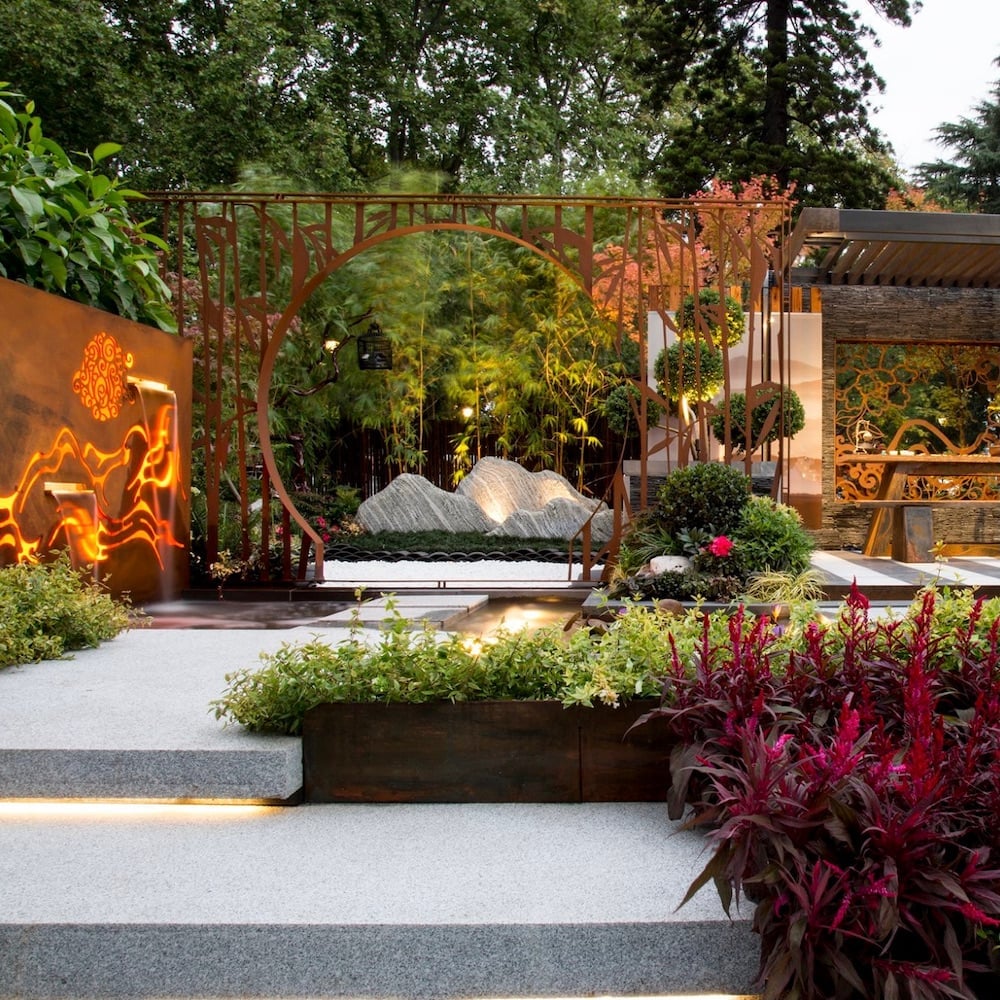
A metal screen with integrated lighting separates the front yard into distinct zones without closing it off. The warm orange and red tones in the plants pick up the light from the screen, while the grey stone and concrete stay cool. The water feature adds sound, which changes how the space feels at night. The lighting is built into the screen structure itself, not tacked on after, so there are no visible fixtures or cords. That kind of integration requires planning during hardscape installation, not something you can add with a plug-in stake.
Naturalistic Rock Garden with Prominent Boulders
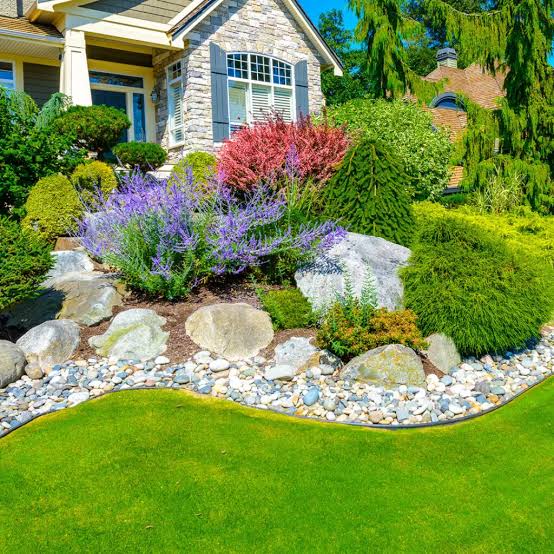
A good rule for a rock garden is to place the largest boulders first, then build the planting around them. In this front yard, the big rocks anchor the bed, with layered shrubs and flowering plants in green, purple, grey, white, and red woven between. Gravel fills the gaps and keeps the look cohesive. The layout matters more than the number of plants. The boulders give the garden its bones, and everything else fills in around them.
Expansive Naturalistic Front Yard with Winding Stone Path
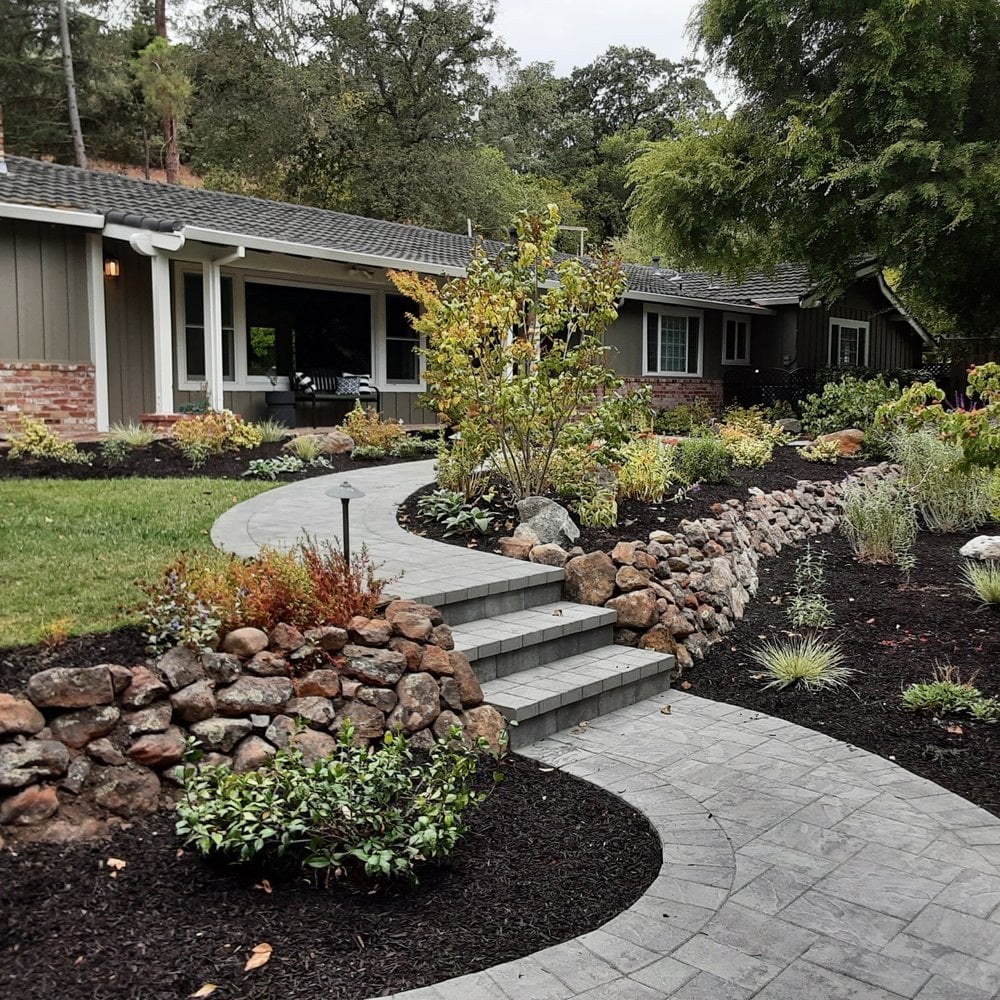
A straight path would have made this yard feel shorter. Instead, the curving stone pathway slows the eye and makes the space feel larger. Stacked stone retaining walls follow the same curve, creating a natural flow from road to front door.
The palette stays muted: grey stone, brown mulch, rust and green from the plants, so the path remains the main event. The overcast light softens the contrast, which helps the whole yard read as one continuous landscape.
Charming Cottage Garden Front Yard with Picket Fence
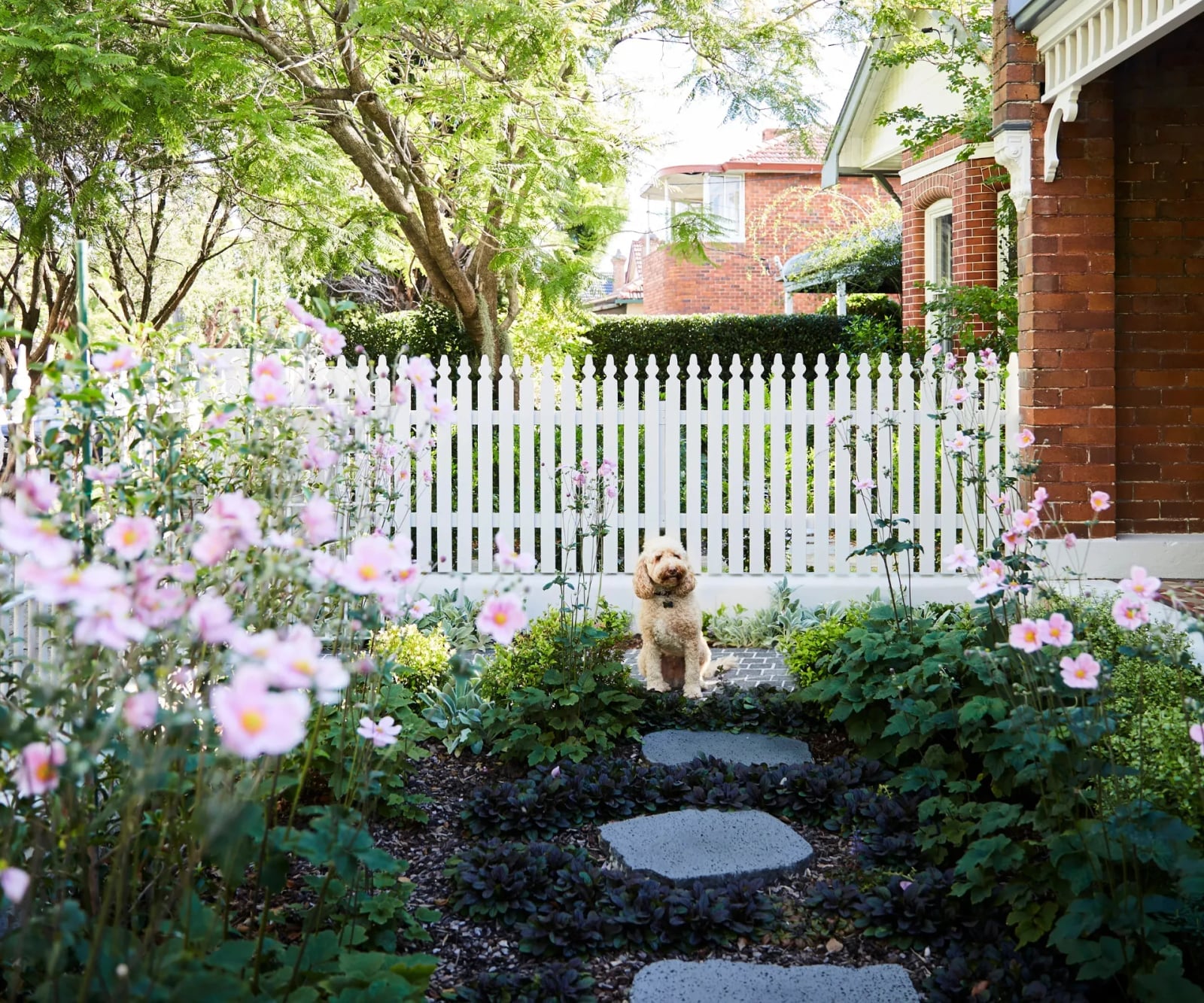
The white picket fence does more than mark a boundary. It frames the planting so the pink flowers and brick red stepping stones read as a deliberate composition. A dog sitting on the path adds a living focal point, but the design would work just as well without one. The wood fence and stone path give the garden a grounded, traditional feel that suits a cottage style.
Modern Front Yard with Tiered Stone Retaining Walls
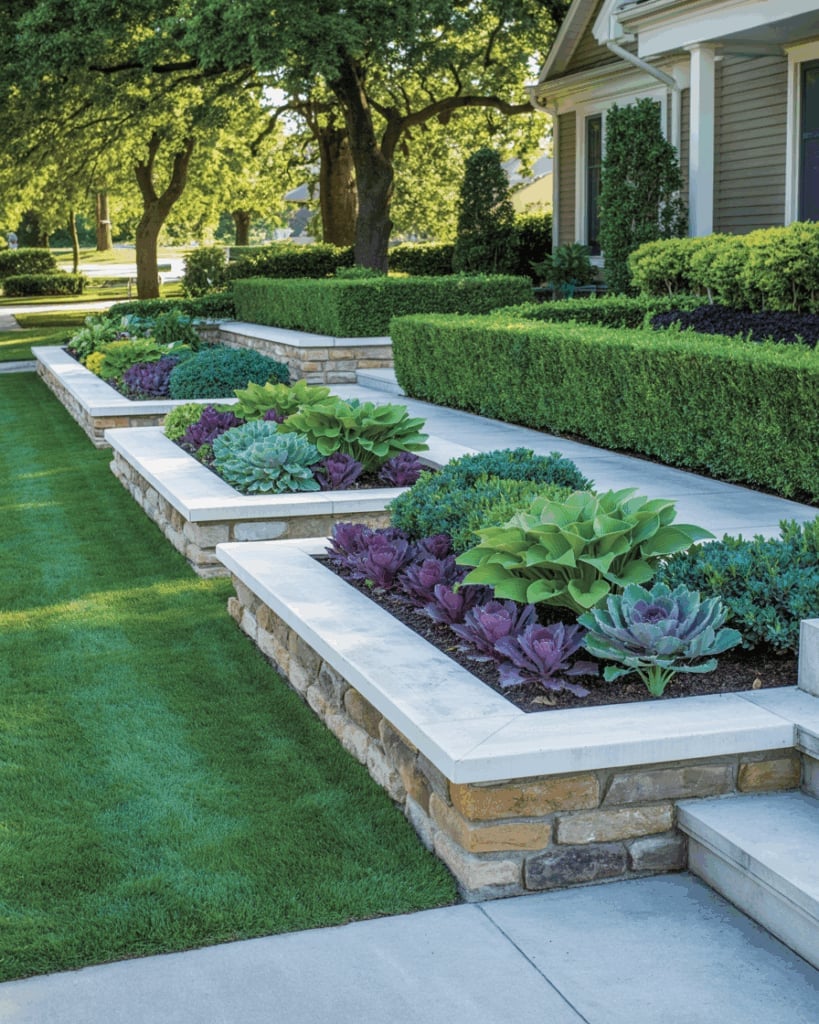
Tiered stone retaining walls solve a slope problem while adding structure. This front yard uses the raised beds to separate zones: ornamental plants in green and purple fill the upper level, while the lower beds hold softer foliage. The daylight hits the stone and concrete at different angles as the sun moves, which gives the facade a changing texture. For a renter, a similar effect works with stacked concrete blocks and potted plants on each tier.
Informal Garden Front Yard with Curved Planting Beds
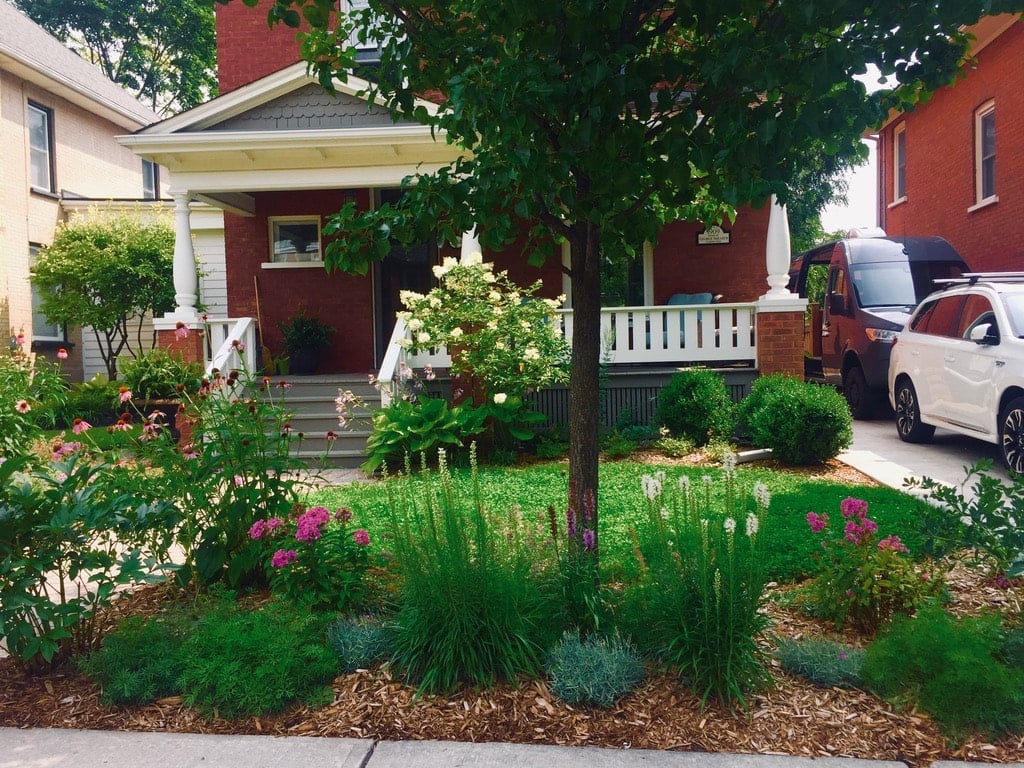
Curved planting beds break the grid of a traditional lawn and make a front yard feel more relaxed. This garden uses the curves to group flowering shrubs and ornamental grass, with a stone pathway following the same line. The bright daytime light keeps the green, pink, and white palette from looking muddy.
Mulch covers the soil between plants, which cuts down on weeding and keeps moisture in. For a yard without built-in beds, marking a curve with a garden hose and edging it with stone or brick gives the same informal shape without heavy digging.
Modern Front Yard with Concrete Stepping Stones
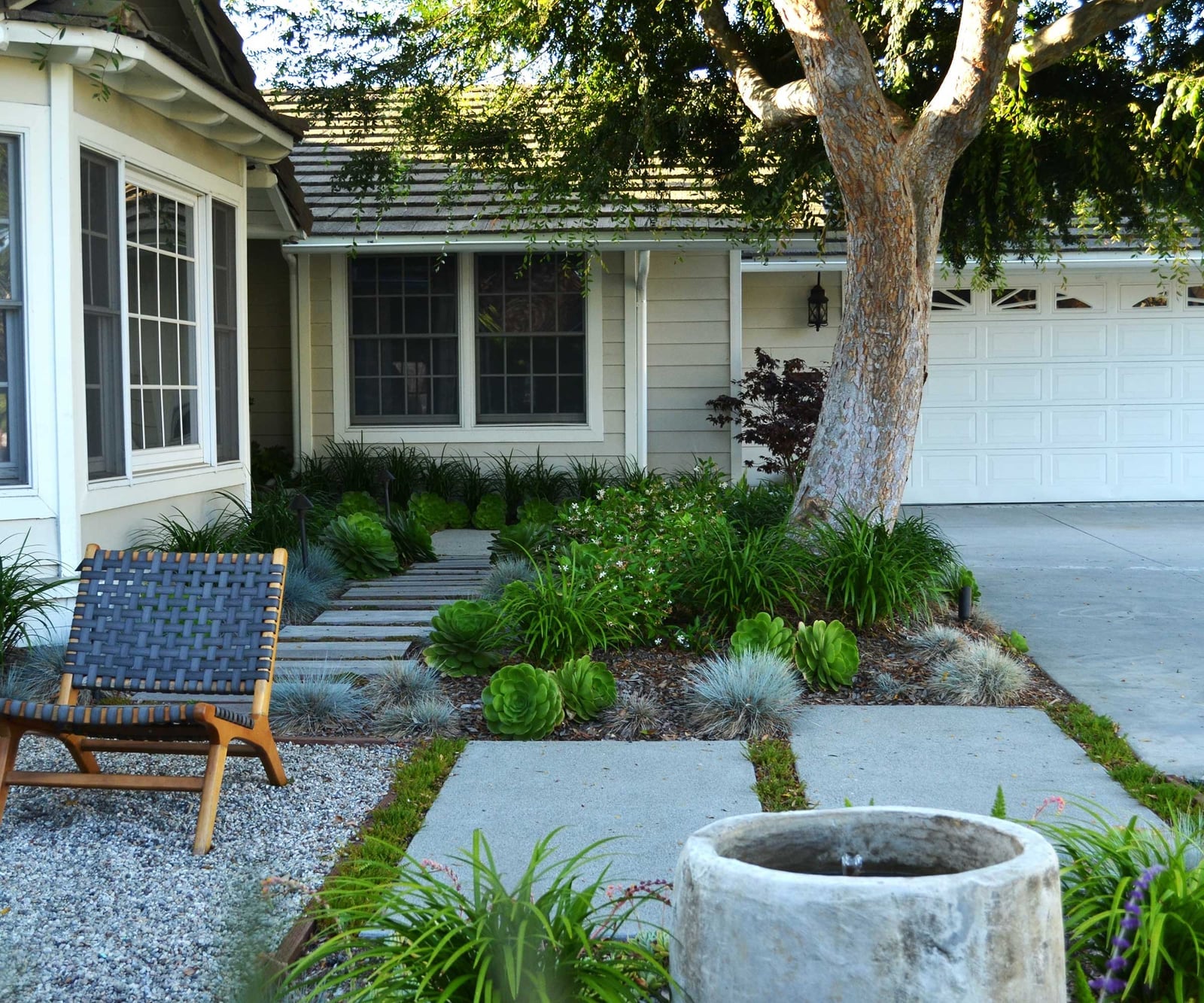
A modern front yard landscape design often relies on hard materials to shape the space, and concrete stepping stones set into gravel beds do exactly that. A bright green lawn sits off to the side, while a modern chair and a concrete water feature anchor the planting area. The contrast between soft greenery and grey aggregate keeps the layout defined without extra fuss. The path itself works as a practical route from driveway to entry, and the wood elements add just enough warmth to keep the palette from reading as purely industrial.
Rustic Patio with Abundant Potted Plants
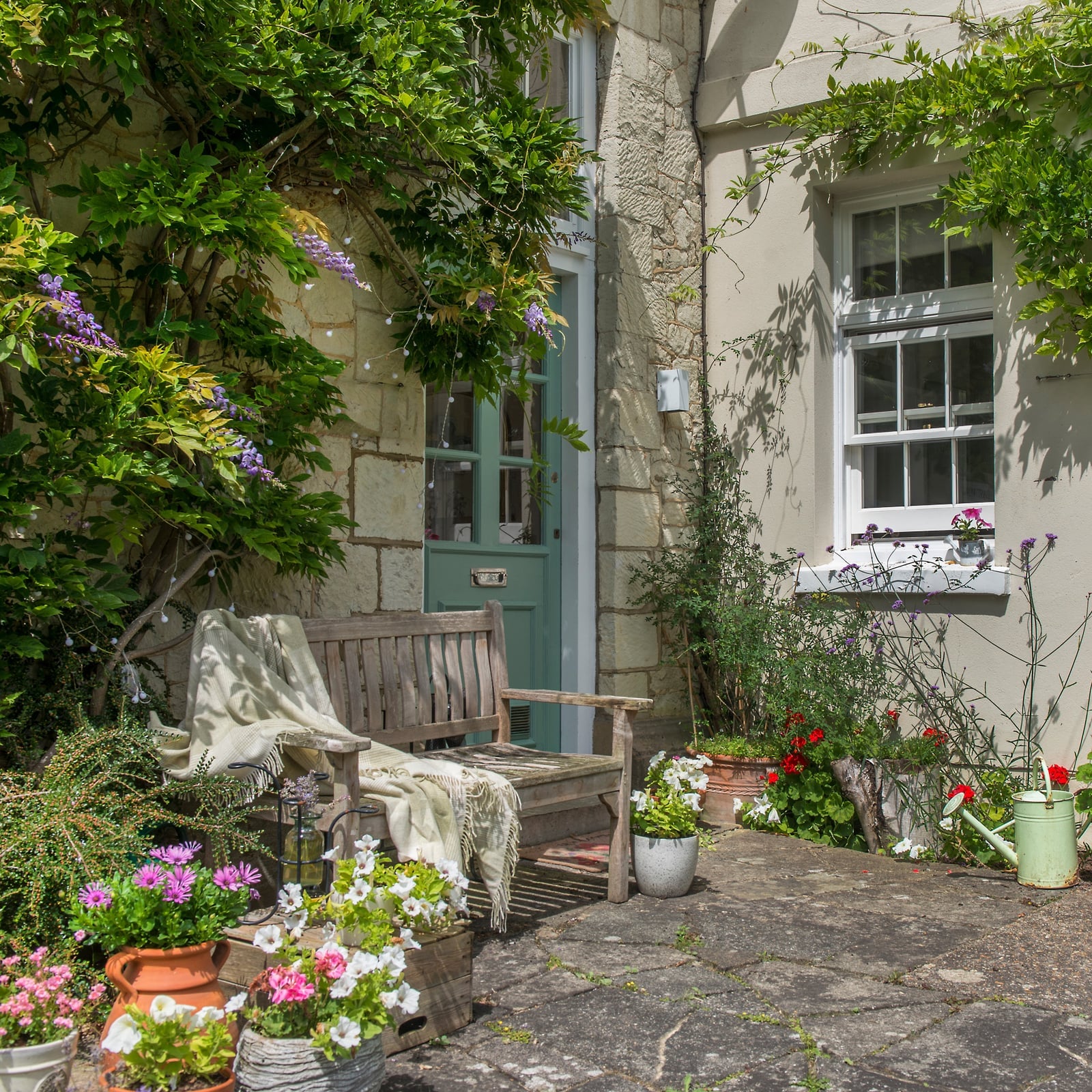
Group pots in odd numbers and vary their heights for a patio that looks established right away. A wooden bench against a stone wall becomes the anchor, surrounded by terracotta and metal containers in cream, pink, and green tones. A metal watering can sits nearby as a subtle functional detail. The palette leans into the soft pastel and earthy range that defines cottage garden style, with the terracotta reds breaking the green-and-cream ratio enough to avoid uniformity. For renters, this setup is a solid move: nothing is planted in the ground, and every piece can shift with a new address.
Naturalistic Front Yard with Irregular Flagstone Pathway
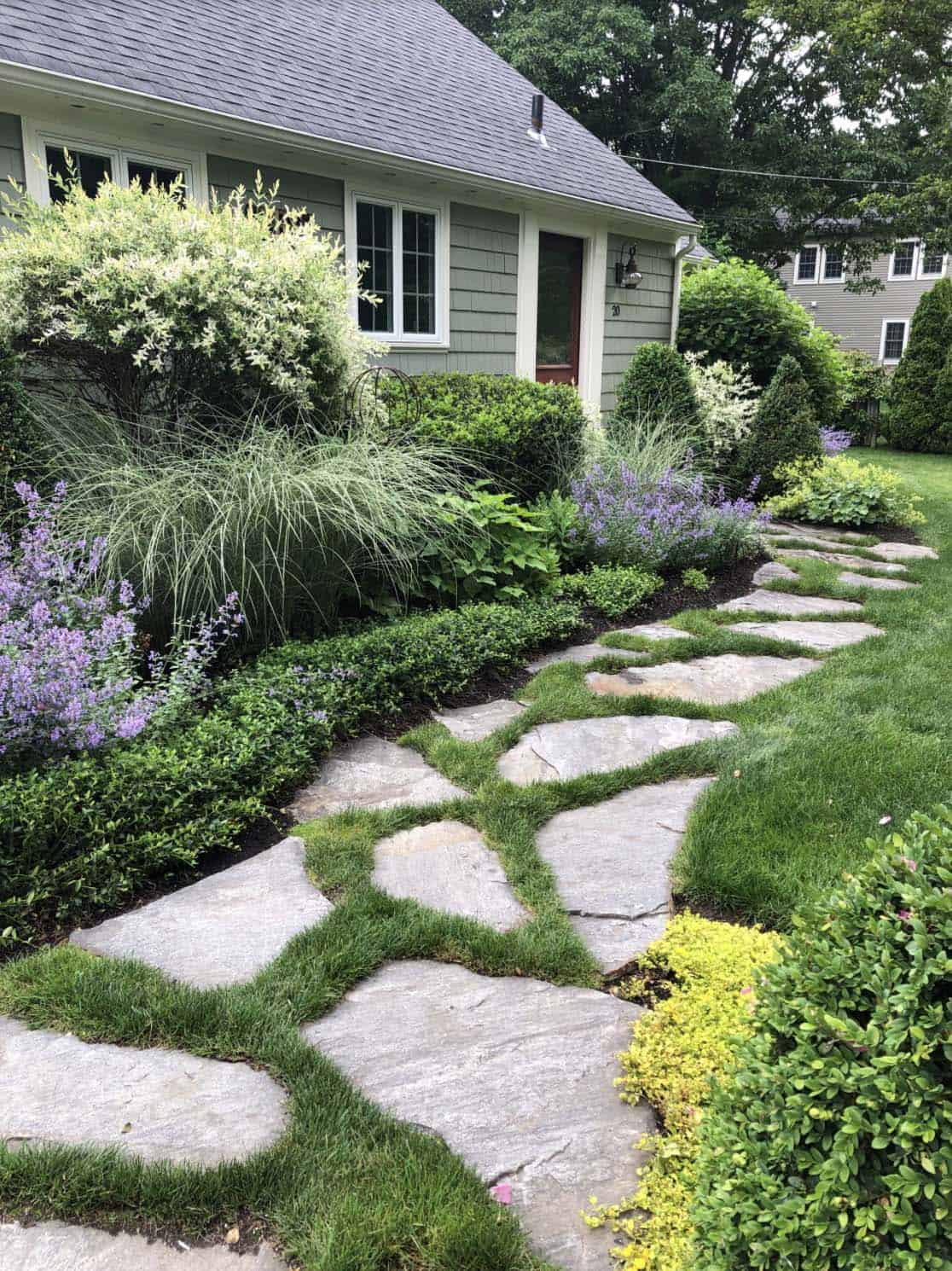
A close alternative to a straight concrete walkway is an irregular flagstone path set into a lawn, which looks more relaxed and better suited to a yard with naturalistic planting. The stones vary in size and shape, with grass filling the gaps between them, so the path blends into the garden instead of cutting through it. The palette includes grey and green, with purple flowers and brown mulch adding depth.
The wider framing shows how the winding route softens the transition from street to entrance. Mulch beds on either side keep the lawn edge defined, and the layered plantings rise in height toward the house. This approach works best when the stones are set at a consistent depth so mowing around them stays straightforward.
Coastal Front Entrance with Vibrant Teal Door
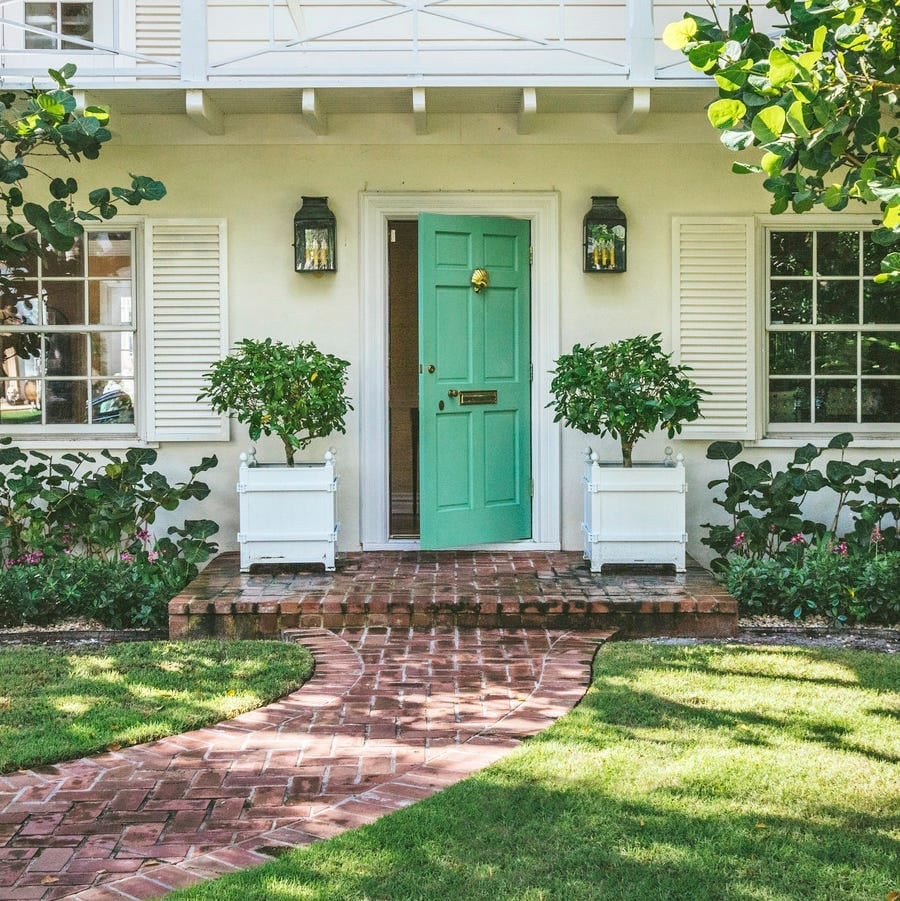
A teal front door against a white facade is the kind of color choice that defines the whole entry without needing much else. Brick red pathways and green potted trees flank the entrance, creating a symmetrical layout that feels grounded and welcoming. The palette here is what makes it coastal: the teal reads as water, the brick as warm earth, and the white as sky or sand. Metal lanterns on either side of the door reinforce the style without overwhelming the composition. A front yard landscape design that leads the eye straight to a colored door keeps the arrival sequence simple and effective.
Naturalistic Front Yard with Winding Flagstone Path
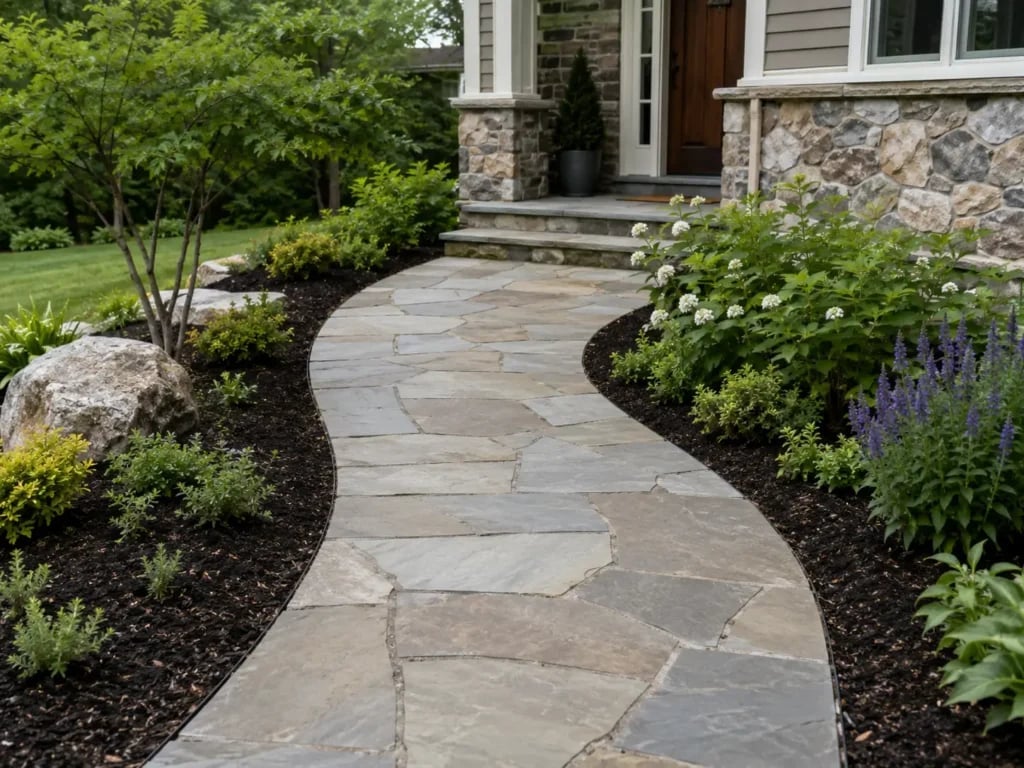
A winding flagstone path is the strongest visual element in this open front yard, and it earns that role by controlling how you move through the space. The stones are laid in a gentle curve that follows the natural slope of the lot, with mulch beds and layered shrubs softening the edges. The grey stone contrasts with the brown mulch and green foliage without competing for attention. This kind of layout suits a yard where the goal is to let the path guide visitors instead of forcing a straight line. Keeping the path width consistent from start to finish ensures the curve looks deliberate.
Naturalistic Front Yard with Dense Greenery
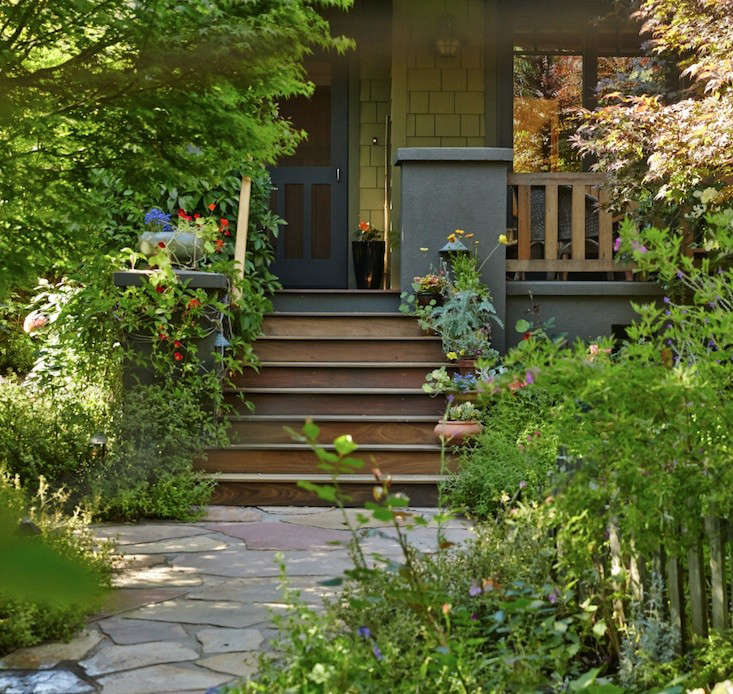
When the goal is a front yard that feels established from day one, dense planting is the shortcut. A stone pathway cuts through layers of green, yellow, and pink, with foliage that reaches right to the edge of the walk. The wooden fence at the back holds the line between garden and neighbor, so the planting can stay loose without looking unkempt. The layout does the work here: a clear path through the middle keeps the yard walkable while everything else fills in. Soft daytime light filters through the varied leaves, and that mix of heights and textures gives naturalistic style its finished look.
Rustic Farmhouse Front Yard with Stone Steps
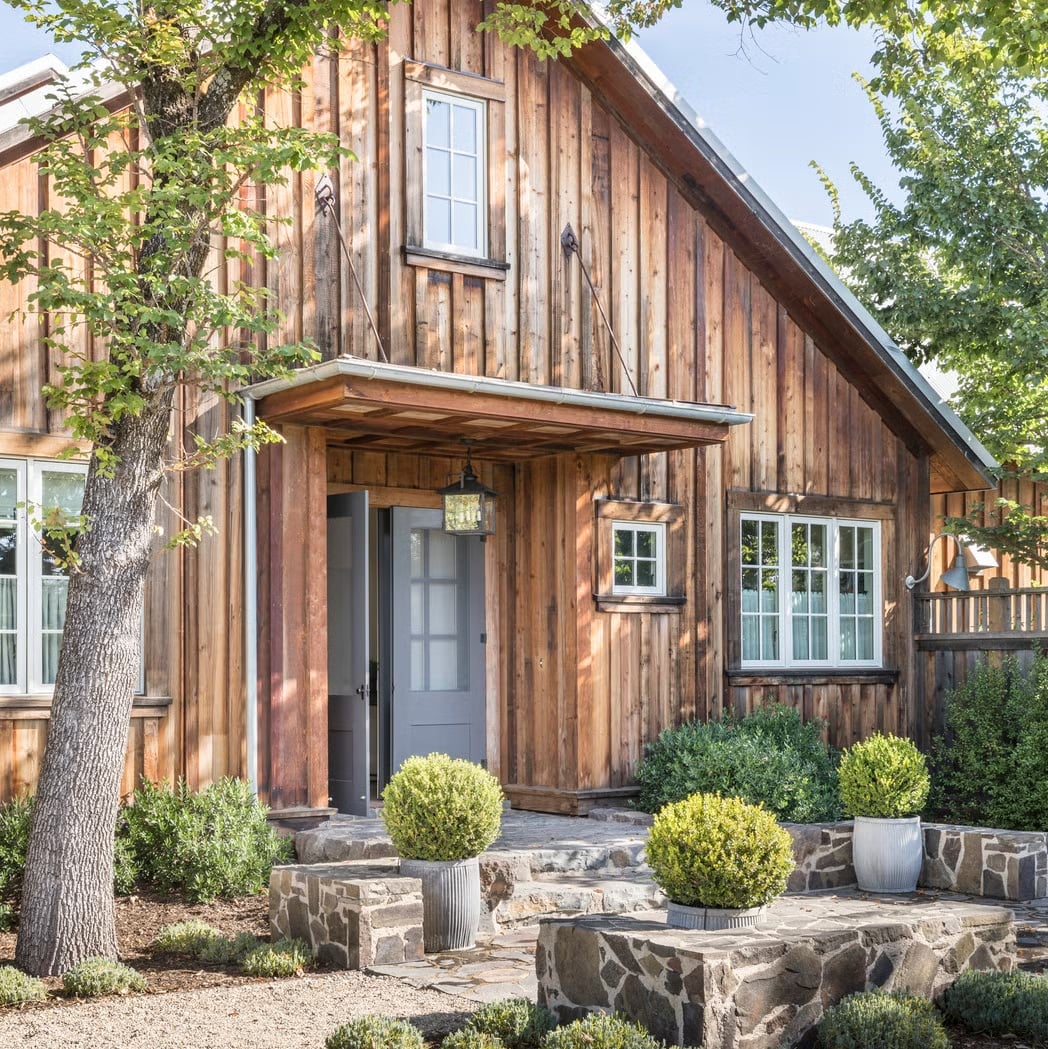
A wooden house with natural wood siding sets the tone for a rustic farmhouse front yard. Stone steps lead up from a gravel path, flanked by concrete planters filled with boxwood. The grey of the stone and the green of the shrubs keep the palette simple, letting the warm wood of the siding be the main event. The compact layout means every material earns its place, and the concrete planters add a solid, permanent feel that matches the house.
Vibrant Cottage Garden Front Yard with Layered Planting
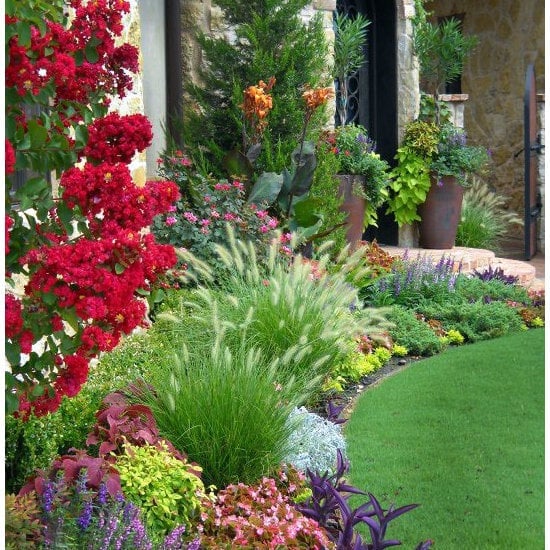
A practical rule for cottage garden planting is to layer by height and bloom time, so something is always in color. Here, a crepe myrtle stands behind ornamental grass and potted plants, with red, purple, orange, and yellow flowers filling the space between. The curved beds pull the eye toward the entrance, and the stone path keeps the layout grounded. The palette is the anchor: warm tones in the foreground, green as the backdrop. That ratio of two-thirds green to one-third bright color is what keeps a cottage garden from reading as chaotic.
Modern Garden Front Yard with Decorative Spheres
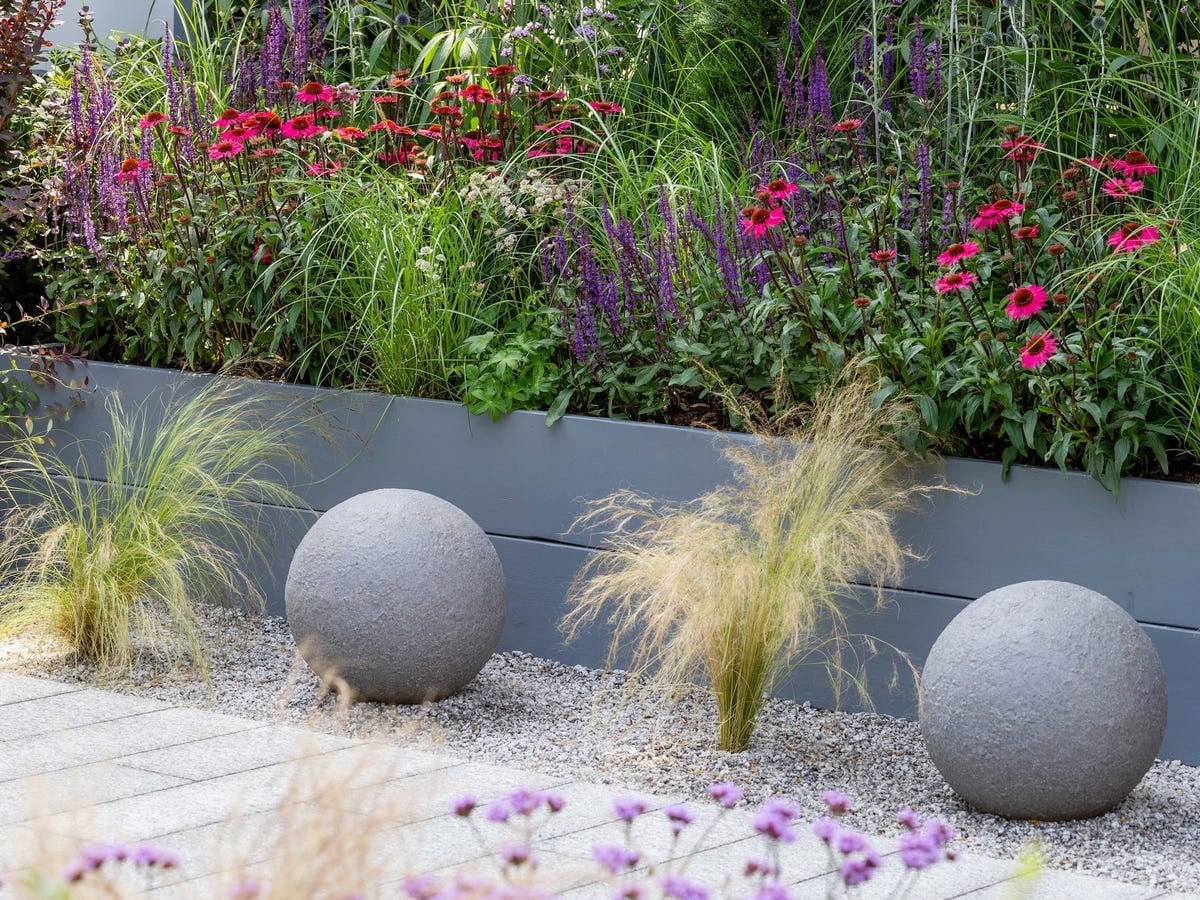
A modern garden front yard can rely on a single sculptural element instead of layers of blooms. Here, large grey spheres sit in a raised concrete planter, surrounded by ornamental grass and gravel. The shape breaks the usual plant-only rule, and the soft grass against hard spheres keeps the eye moving. Daylight hits the spheres evenly, so they appear as solid forms. The gravel path below echoes the grey of the spheres, tying the whole layout together without adding noise.
Expansive Country Garden with Winding Gravel Path
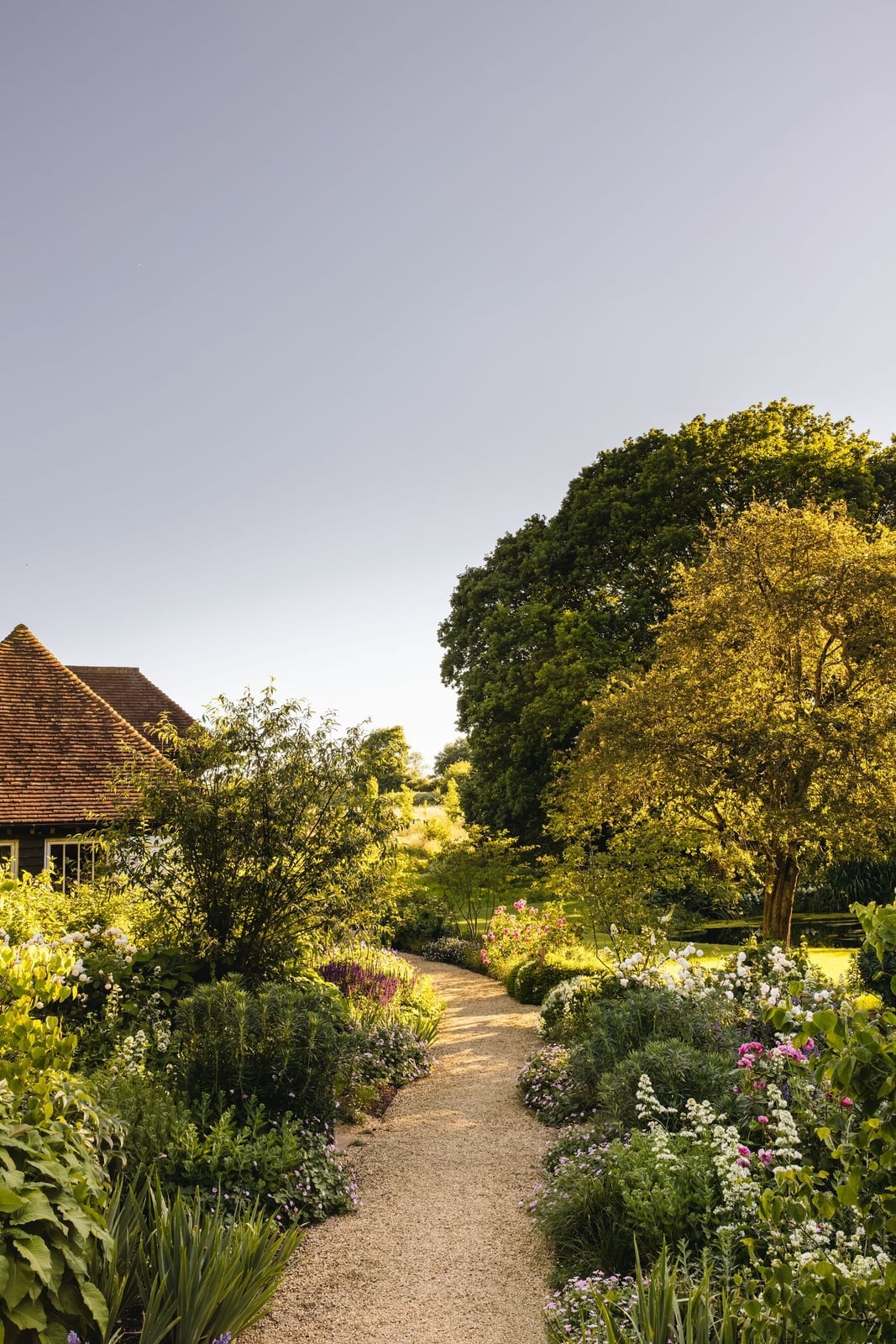
Golden hour light turns a winding gravel path into the main attraction in an expansive country garden. The path curves through mature trees and flowering plants in green, yellow, pink, and white, with the late afternoon sun creating dappled shadows. The warm light makes the gravel glow and the flowers pop, a reminder that timing matters in garden design. The layout uses the path as a slow reveal, inviting a walk instead of a straight march to the door.
Vibrant Cottage Garden Front Yard with Brick Pathway
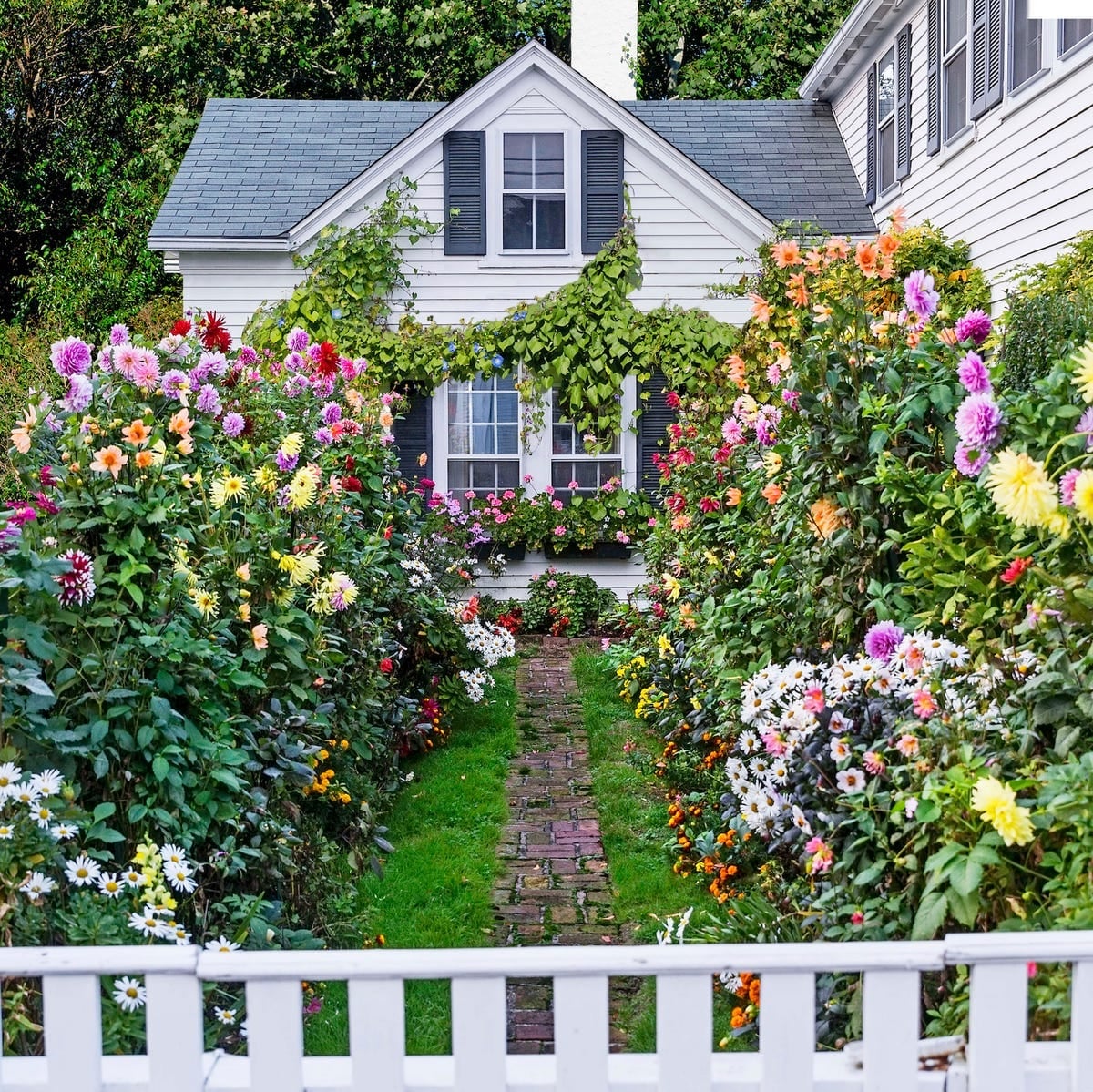
A cottage garden front yard with a brick pathway and abundant flowers uses layout as its main tool. The path runs straight between dense, multi-colored flower beds, with a white picket fence behind them. The palette stays in pastels, so the greenery reads as a calm backdrop against the blooms. The layout principle here is to let the path divide the space into two equal planting zones, which gives the eye a clear route while the flowers spill over the edges. The brick path keeps the footing solid even when the beds are at their fullest. For renters, the brick path and fence are permanent, but the flower beds can shift each season by swapping in annuals that match the existing pastel palette.
Formal Garden with Symmetrical Lawn and Pergola
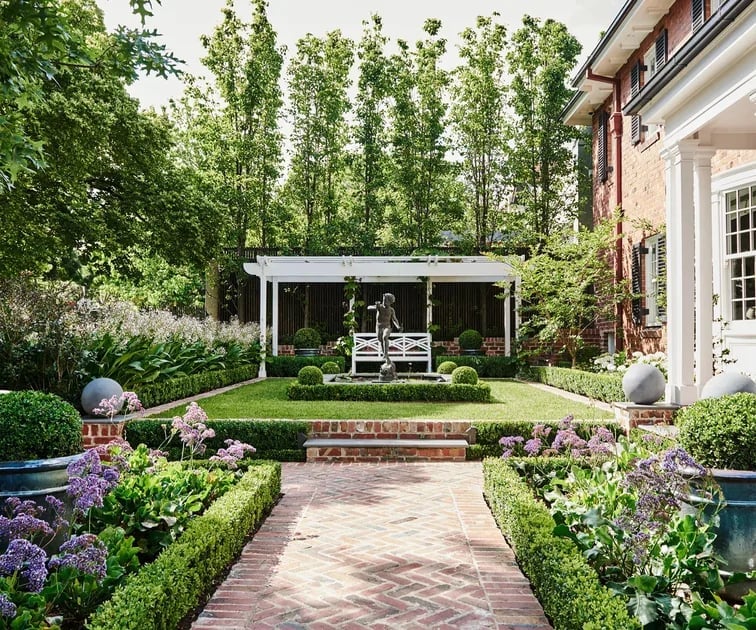
Symmetry does the organizing so you need fewer pieces. This garden centers on a rectangular lawn with a white pergola at the far end, then mirrors the hardscape on each side. Brick paths run parallel to the lawn, flanked by manicured hedges and stone urns, with a bench placed under the pergola. The palette stays restrained green, white, brick red, and grey which reinforces the orderly feel. Every element has a twin across the center line, so the space feels complete even with only a handful of features. For renters, the lawn and pergola are fixed, but you can add symmetry with matching potted shrubs or identical urns on each side of the door.
Naturalistic Garden with Diverse Native Plantings
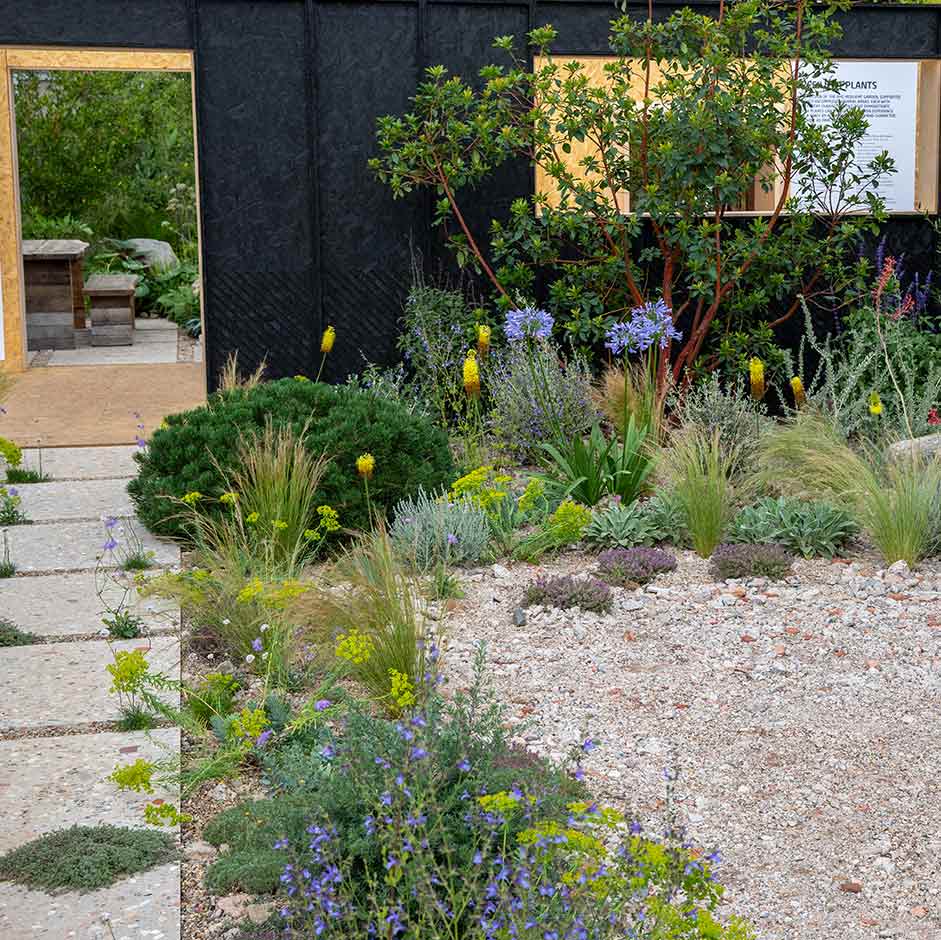
The design uses a winding stone path through layered planting beds to create a naturalistic garden that feels established rather than arranged. The palette mixes green foliage with purple, yellow, and grey tones from diverse native plants and ornamental grasses, all set against a gravel base. The material principle here is contrast: the soft, irregular shapes of the plants stand out against the hard, angular gravel and stone. The path curves through the beds rather than cutting straight, which makes the garden feel larger because you cannot see the full route at once. For renters, the gravel and stone path are low-commitment, and you can build the layered planting over time with potted natives suited to your USDA zone.
Traditional Front Entrance with Stone Facade and Topiaries
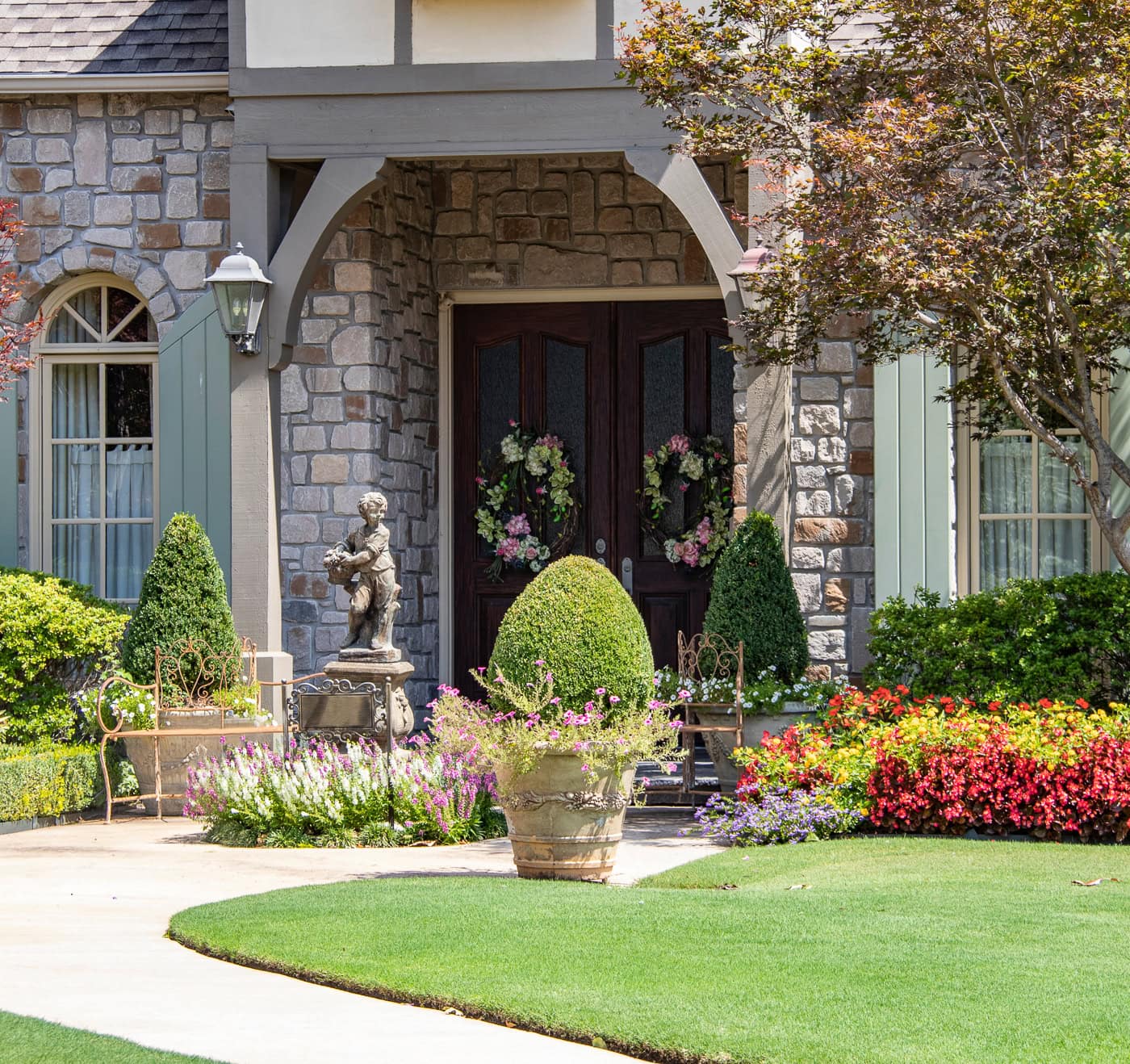
The traditional front entrance relies on a precise observation about scale: the stone facade sets a heavy backdrop, so the greenery needs equal visual weight. Topiaries in large planters flank the door, with wreaths on the doors and flower beds at the base. The palette uses green, red, pink, and white against the neutral stone and brick, with metal benches adding a dark accent. The styling principle: repeat the same plant form topiaries here in matching pots to create a rhythm that leads the eye to the entrance. For renters, the stone and brick are permanent, but you can add the topiaries and wreaths without altering the structure, and swap the flower bed colors each season.
Traditional Front Yard with Geometric Concrete Pathway
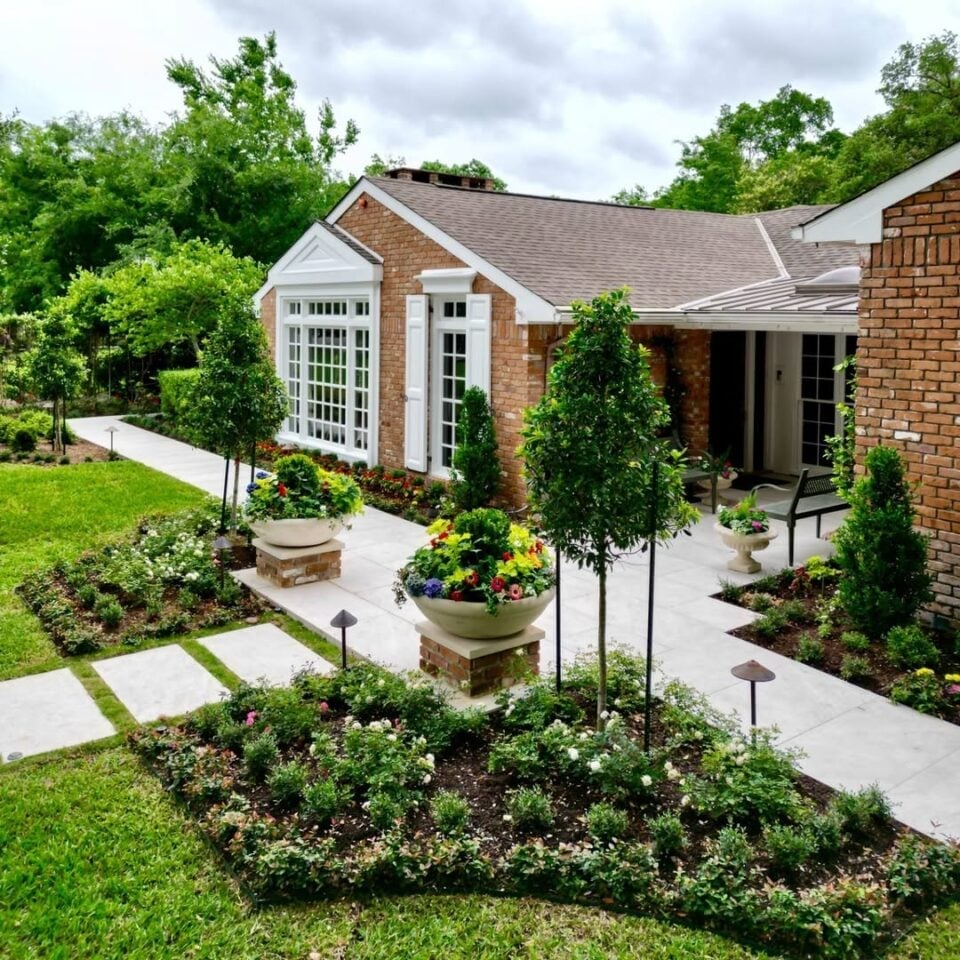
This traditional front yard sets itself apart from looser cottage or naturalistic styles by using a geometric concrete pathway as the backbone. The path runs in straight lines and right angles, with large planters placed at key intersections and manicured trees in symmetrical beds. The palette mixes green with white, red, yellow, and pink flowers, all set against the grey concrete and brick edging. The layout principle: the geometric path divides the yard into clear zones, so the planting beds and trees each have a defined place rather than blending together. This makes the yard look manicured even when the flowers are at their peak. For renters, the concrete path is permanent, but you can adjust the planters and trees to your preferred color scheme without changing the hardscape.
Secret Garden Feel with Brick Pathway and Archway
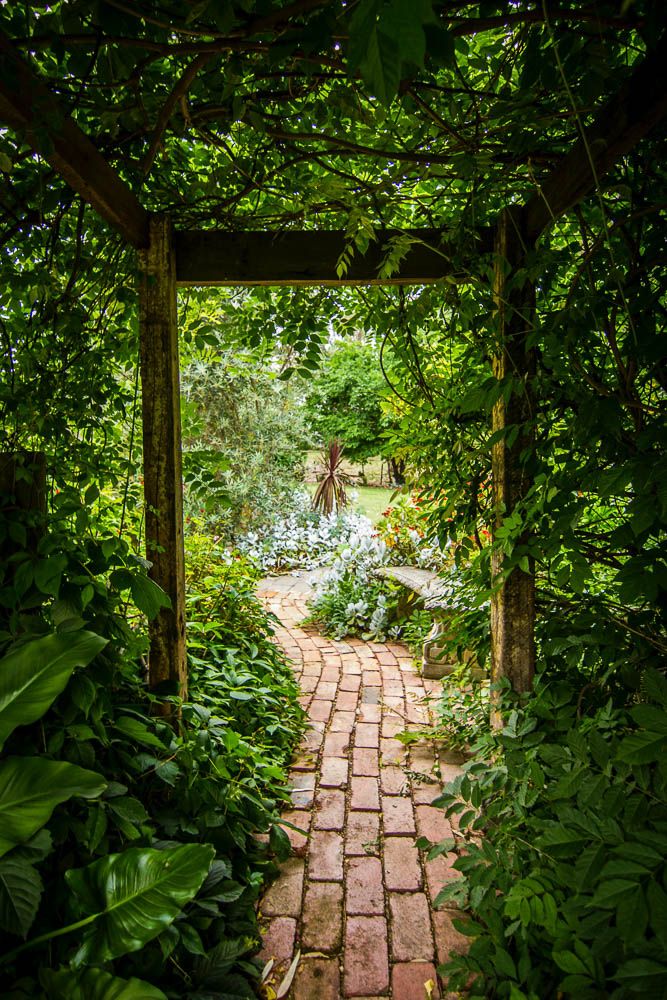
A brick pathway that curves out of sight invites the kind of curiosity that makes a small front garden feel much larger. The warm red-brown of the brick plays against deep green foliage and the grey of a stone bench, while a wooden archway frames the view ahead. This layout works because the path never reveals its full length at once. Each turn hides what comes next, so the eye keeps moving. The archway adds vertical structure without blocking light, and the bench gives you a reason to pause. Scale here is about creating layers. The path stays narrow to keep the planting dense and the journey intimate.
Cottage Garden Side Yard with Mossy Flagstone Path
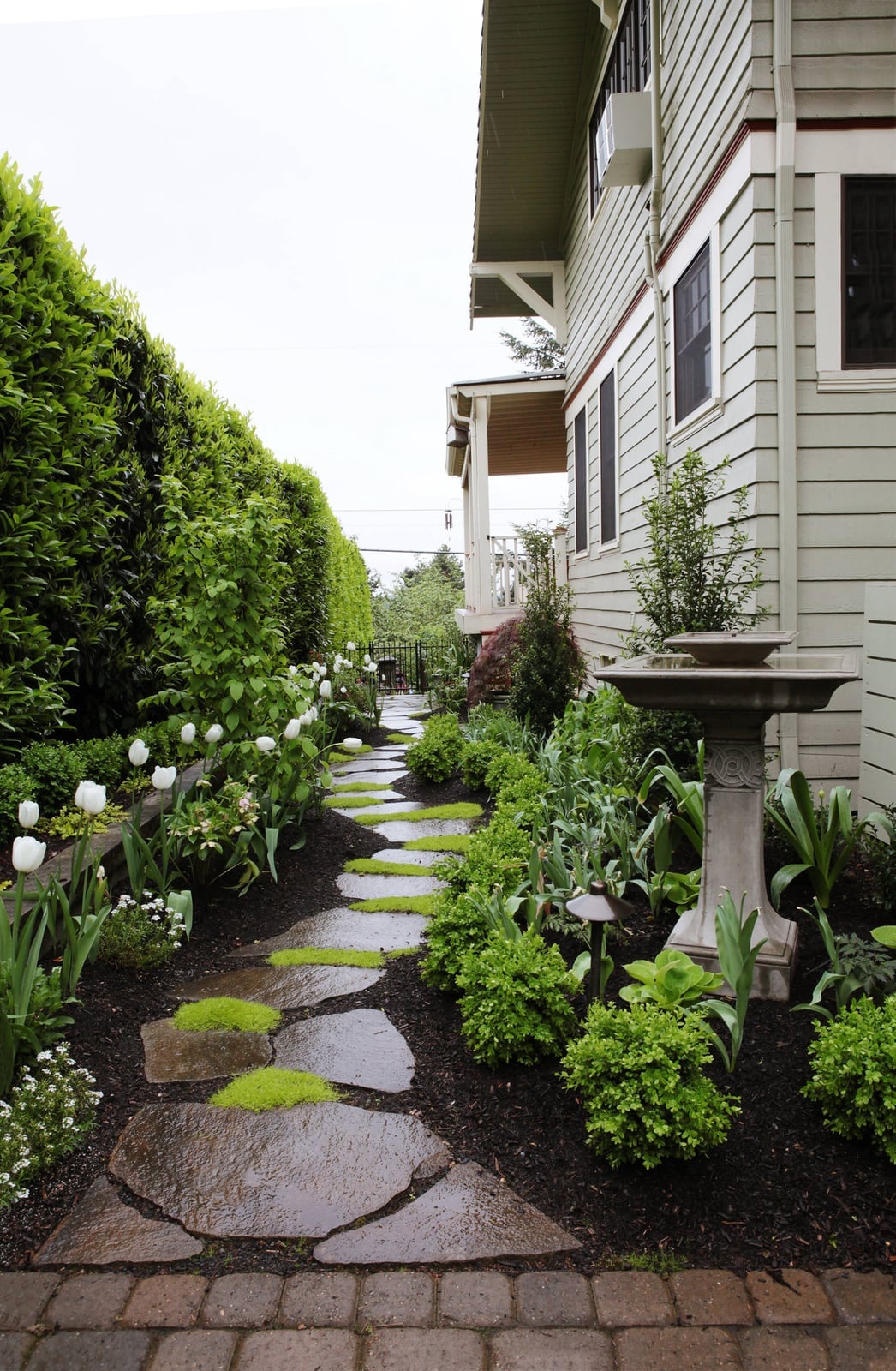
A mossy flagstone path is about as durable as garden hardscaping gets, and this side yard proves why that matters. The irregular stones are set into a bed of dark mulch, with cracks softened by low greenery. Tulips rise in white and pale pink along the edges, and a bird bath sits off to one side. The path handles foot traffic without shifting because the stones are heavy and the gaps are small. Moss fills the joints naturally, which also keeps weeds from taking hold. Overcast light makes the grey stone and white flowers read as soft and cool. For a side yard that gets steady use, this kind of path holds up to weather and wear without needing much attention.
Desert Modern Front Yard with Drought-Tolerant Plants
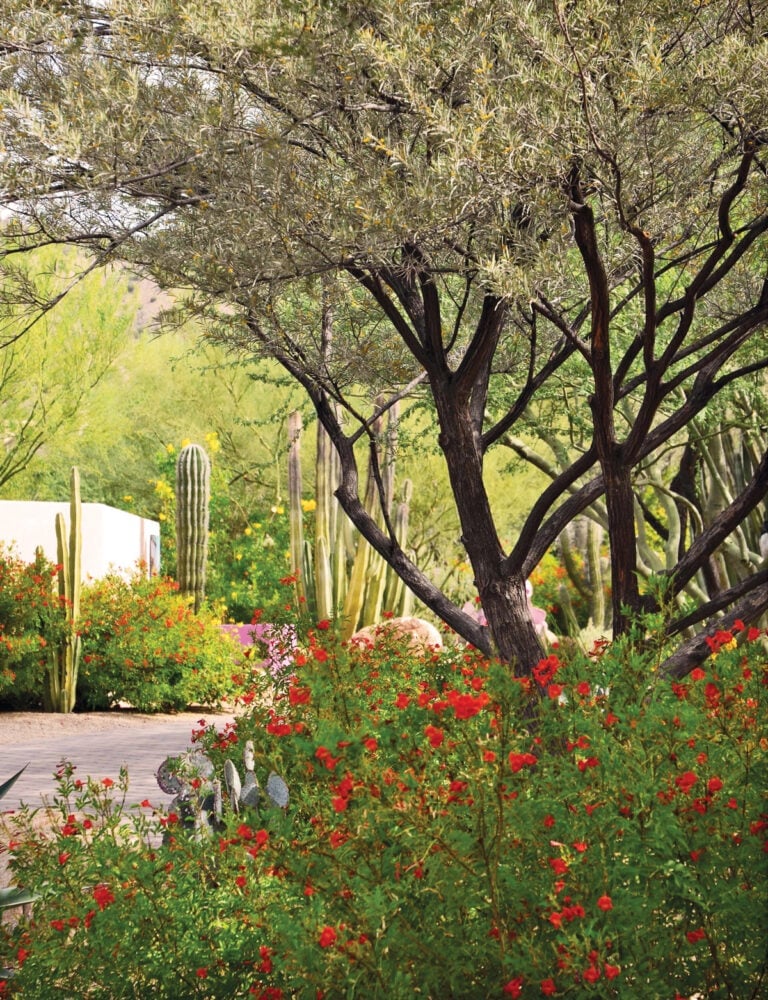
A desert modern front yard swaps the thirst of a lawn for the texture of stone, gravel, and succulents, but that does not mean it looks sparse. This one layers cacti, flowering shrubs, and trees in beds edged with concrete, with a winding gravel path connecting the front door to the street. The palette includes greens, reds, browns, and beige, which mirrors the surrounding landscape without fighting it. The material mix matters here. Smooth river stone sits near rough gravel, and the stucco wall of the house provides a neutral backdrop. Vibrant red flowers punch against the muted desert tones, which keeps the yard from feeling monochrome. For a roomy front yard in a dry climate, this approach cuts water use while still giving you color and structure.
Cottage Style Backyard with Fire Pit Area
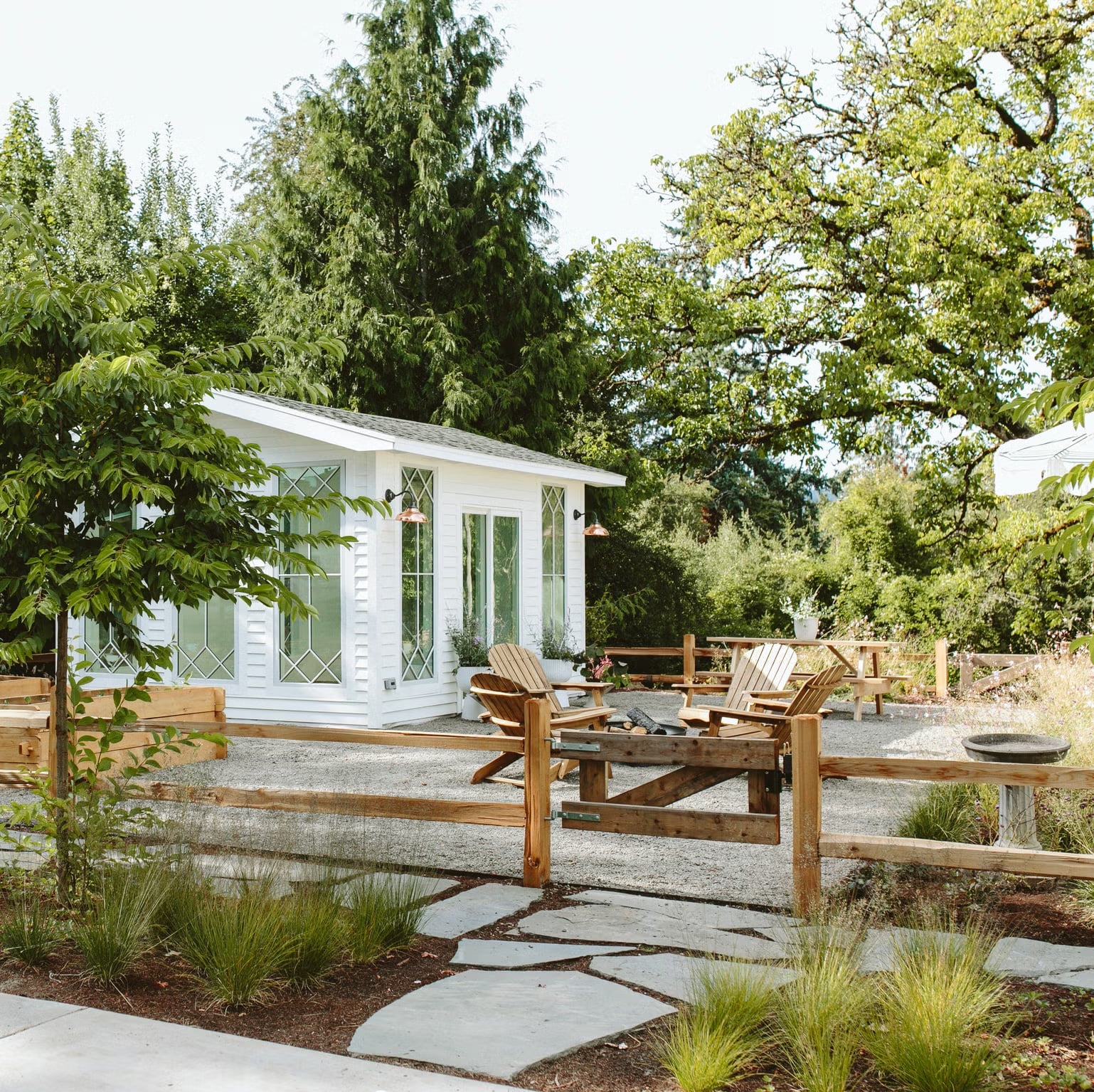
A fire pit anchors this backyard, set within a loose circle of wooden chairs on gravel. A white structure off to one side adds the cottage character, while a bird bath keeps the garden feeling lived in. The key swap here is gravel instead of a solid patio. Gravel drains fast, shifts underfoot in a way that feels relaxed, and costs less to install than poured concrete or flagstone. The wooden chairs are basic and unpainted, which lets the fire pit and the greenery carry the look. Soft daylight filters through the trees, keeping the scene from feeling harsh. For a backyard that you want to feel casual and welcoming, gravel and simple furniture get the job done without overcomplicating the layout.
Modern Natural Front Yard with Central Fire Pit
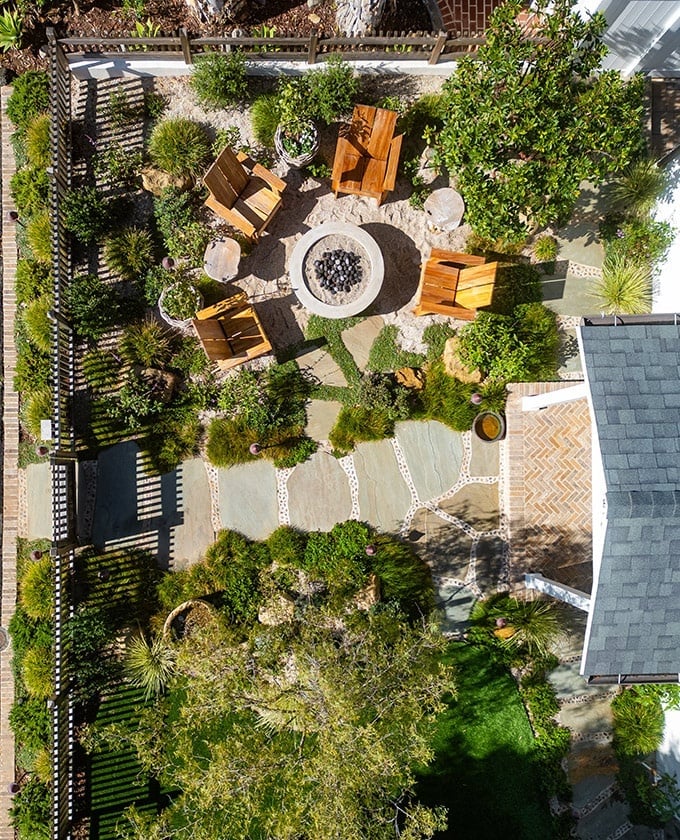
A front yard that puts a fire pit at the center changes how you use the whole property. In this aerial view, the fire pit sits in a gravel circle with wooden chairs arranged around it, and stone pathways radiate out toward the house and the street. The layout is open plan, with varied planting around the edges rather than blocking the center. That matters because a fire pit needs clearance. The paths are wide enough for two people to walk side by side, and the gravel extends far enough to keep embers away from dry grass. Greens, greys, and wood tones keep the palette natural. For a front yard that doubles as a gathering space, this layout turns a walkway into a destination without adding a single wall.
Final Thoughts
A well-planned front yard makes coming home feel good and keeps maintenance manageable. The best designs start with a clear idea of how you want the space to live: a straight path for efficiency, a curved one for exploration, or dense plantings for privacy. Pair your layout with materials that suit your climate and your skill level. Gravel needs occasional raking, flagstone can shift over time, and concrete stays stable with little fuss. Check your USDA zone before choosing plants to avoid replanting every season. Take your time with the plan. A front yard that works for you and your neighbors is worth the extra thought.